Nature
 PUBLISHED


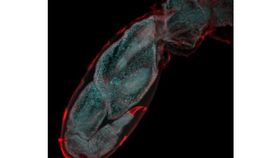


Sometimes, real life beats science fiction to the punch by coming up with mind-blowing ideas millions of years before they are dreamed up by novelists, screenplay writers, or comic books artists. Body part regeneration is one of the best examples of this, and is just another mundane fact of life for many animals, as can be seen in this incredible video of cellular activity in the amputated leg of a crustacean as it regrows.
This amazing footage shows a Parhyale hawaiensis, a relative of the sand hopper, viewed under a microscope. Outlining their work in the journal eLife, researchers from the Institute of Functional Genomics in France reveal that they chose this particular crustacean because it regenerates lost limbs extremely quickly, taking less than a week to regrow a whole leg.
The fact that these legs are transparent and incredibly thin, measuring less than 100 micrometers in diameter, also meant that the team were able to record the process with single-cell resolution through the entire thickness of the leg.
In order to achieve this, the researchers first genetically engineered the epidermal cells in the leg stump in order make their nuclei glow, thereby making it easier to track their movement and activity.
“Using this method, we identified a specific sequence of events and cell behaviours that unfold during limb regrowth,” explained study co-author Frederike Alwes in a statement. “These include wound closure, followed by a quiet period when the epidermal cells migrate slowly towards the site of the wound, which then leads to extensive cell division and movement as the new leg starts to develop its shape.”
This in itself is extremely interesting, as it reveals that regenerated limbs are not created from stem cells, but from existing epidermal cells that simply divide in order to create a brand new leg.
Equally fascinating is the discovery that all of these cells appear to start dividing at exactly the same moment, suggesting that the entire process of limb regeneration is controlled by a single signal – although the source of this starting gun is something that the team are yet to identify.