Humans
 PUBLISHED
 2
2



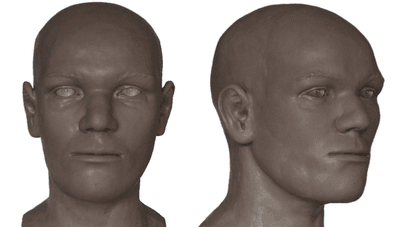


The first humans to settle in Europe after leaving Africa had broad noses and wide faces, according to a new analysis of a 45,000-year-old skull from the Czech Republic. Belonging to a prehistoric population known as the Zlatý kůň (ZK), this woman lived just a few millennia after ancient Homo sapiens first interbred with Neanderthals.
Originally discovered in 1950, the ZK skull is currently housed at the National Museum in Prague and is remarkably well preserved for its age. Due to its excellent condition, researchers found that the skull lends itself well to several different methods to approximate the shape of her face.
They therefore performed three separate types of facial reconstruction on the prehistoric skull. The first involved mapping known soft tissue thicknesses and facial muscles onto the fossil, resulting in what the study authors have labeled model A.
To create model B, the researchers recruited expert palaeoartist and sculptor Élisabeth Daynès, who used the team’s data to produce a “hyperrealistic manual facial approximation”.
Finally, the authors conducted a virtual facial approximation by digitally mapping 78 separate anatomical bony landmarks onto the skull, giving rise to model C.
Overall, models A and B were the most similar to each other, both displaying “short and wide noses, wide nasal bridge but a less prominent rounded nasal tip.” In contrast, model C displayed a more vaulted forehead, narrower nose, and pointed chin, resulting in “a distinctly triangular facial shape.”
When comparing these three reconstructions with photographs of modern Czech and Cameroonian women, the researchers noted that A and B fell very much with the variation seen in the Cameroonian sample, while C was somewhat more shifted toward the Czech profile.
Genetic analysis of the ZK specimen has indicated that she likely had dark skin, eyes, and hair – characteristics that were typical of the first humans to leave Africa. Only much later did lighter pigmentation develop as an adaptation to life in northerly latitudes where sunlight was less intense.
The study authors also note that broad noses and wide faces convey certain advantages in warm, tropical climates, and that the presence of these features in the ZK skull underscores her evolutionary proximity to individuals who lived in Africa.
What’s less clear, however, is how the Neanderthal ancestry of ZK might have influenced her appearance. Genetic data suggests that this individual lived just 80 generations after the main interbreeding event between modern humans and Neanderthals, and before the split between present-day Europeans and East Asians.
Today, different populations carry different amounts of Neanderthal ancestry, which plays a small role in shaping our faces and other traits. However, many aspects of the ZK morphology remain difficult to assess since this prehistoric group represents a human “side branch” that left no genetic legacy within Stone-Age or present-day human populations.
The study is published in the journal npj heritage science.