Space and Physics
 PUBLISHED
 2
2





What we know about the birth of the Sun comes from the many stellar nurseries that we can observe elsewhere in the Universe. Direct evidence is rare, the elements and molecules that were present there have been changed into what the Solar System is like now. But some of those molecules persist and we have been lucky to get them with home delivery: They came to us inside meteors falling down on Earth.
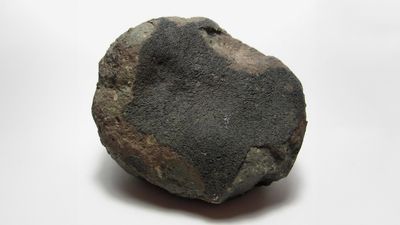
The specks of dust that are older than the Sun are known as presolar grains and survive in several meteorites. One of the most interesting examples of such space rocks is the Allende meteorite, for a variety of scientific reasons. But let’s rewind the clock exactly 55 years. February 8, 1969. At 1:05 local time, a bright fireball lights up the sky above the Mexican state of Chihuahua.
It is roughly the size of a car moving at about 16 kilometers (10 miles) per second. The passage through the atmosphere is fatal, the asteroid is ripped apart, and thousands of fragments are spread over a huge area. This will become one of the largest meteorite strewnfields known, with an area of 8 by 50 kilometers (5 by 30 miles). Fragments continue to be found even today.
It is a carbonaceous chondrite, a specific class of meteorite – the most primitive known as well as fairly rare. Less than 5 percent of all meteorite falls are carbonaceous chondrites. And among the Allende is by far the biggest. Samples found go from 110 kilograms (240 pounds) to a single gram (0.035 ounces). In total, 2 tons have been found and studied – and what insights they have provided scientists.
The meteorite is rich in calcium–aluminum inclusions, or CAI. These are among the oldest formations in the whole Solar System. Inside the CAI, researchers have found, for example, silicon carbide expected to have an age of 7 billion years. Two whole billion years older than the Sun.
The CAI have also provided insights into the environment of the pre-solar nebula, and provided supporting evidence to a scenario. The composition of those grains suggests that just a couple of million years before the birth of the Sun, a supernova went off very close by. Scientists think that this might have played a role, through shockwaves, in the formation of the Solar System.
And it’s not just elements from before the Sun that have intrigued scientists. More complex organic molecules have been found in this object: Amino acids, polymers, and even what are proposed to be fragments of a whole protein. The fragments in the Allende, and the whole one in meteorite Acfer 086, would make the first extraterrestrial protein ever found.
Meteorites are treasure troves and scientists are keen to find as many as possible. Just recently, a bolide broke up over Germany with researchers hunting for fragments in the following days. They found many (not as much as Allende) and it turned out to be an even rarer type.