Technology
 PUBLISHED




After many years of hype, the Hyperloop can often seem like it's stuck being a pipe dream. But SpaceX's Hyperloop Pod Competition this weekend saw some particularly promising designs for the futuristic high-speed transportation system.
Under the eager eye of SpaceX and Tesla Motors CEO Elon Musk, 27 teams of finalists from around the world met to show off their designs for a Hyperloop pod onsite at SpaceX's headquarters in Hawthorne, California. At this stage, many of the pods were sized-down prototypes and not able to carry passengers.
However, three of these teams actually got to demonstrate their technological clout by launching their pods down the 1,250-meter (4,100 feet) low-pressure tube test track. Delft Hyperloop from the University of Technology Delft in the Netherlands, WARR Hyperloop team from the Technical University of Munich in Germany, and the MIT Hyperloop team from the Massachusetts Institute of Technology all took part.
SpaceX built this trio an unspecified method of acceleration that launched the pods up to 80 kilometers per hour (50 miles per hour) into tubes that were depressured for over 30 minutes, according to Ars Technica. Once blasted down the track, the pods hover just above the track using magnetic levitation to reduce friction.
You can watch all three of the teams in action in the video below.
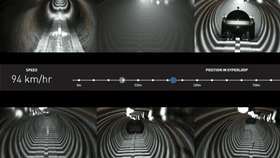
Delft Hyperloop pocketed prize for the highest average speed and the highest overall score, as judged by a gaggle of SpaceX engineers. The most exciting (in our opinion) award for fastest speed down the low-pressure tube was given to WARR Hyperloop team, who managed to hit 94 kilometers per hour (58 miles per hour).
MIT also nabbed the prize for Safety and Reliability, as well as demonstrating their pod was capable of stable magnetic levitation. You can see this in their video below when the wheel stops rotating around the 18-second mark.
One particularly cool little part of this competition was the rLoop Team, an open-source group that was spawned from the hivemind of Reddit, who took home an Innovation Award for their pod design.
The Badgerloop team also won a pod innovation award and even got the 6-foot-2-inches Musk to sit in their 4.5-meter-long (15 feet), 950-kilogram (2,100 pounds) pod, which had been designed with that in mind.
“We were all ecstatic to see Elon sit in our pod,” Badgerloop operations director Claire Holesovsky said in a statement. “He checked out our pod’s technology. It was a great highlight in an incredible week for the team.”
Stay tuned, as Hyperloop Pod Competition II is coming this summer.
Video: MIT Pod Run In A Low-Pressure Hyperloop Track