Humans
 PUBLISHED
 14
14


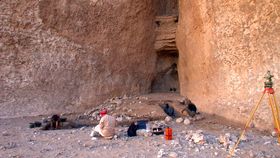


Archeologists have unearthed a number of 8,000-year-old stone tools on the Arabian Peninsula that closely mimic the ones famously crafted by Native Americans up to 13,000 years ago. Despite being separated by thousands of miles and millennia, it appears these two ancient cultures managed to come up with the same idea and develop remarkably similar technology.
"Given their age and the fact that the fluted points from America and Arabia are separated by thousands of kilometers, there is no possible cultural connection between them," Professor Michael Petraglia, an anthropologist from the Max Planck Institute for the Science of Human History who worked on the project, said in a statement. "This is then a clear and excellent example of cultural convergence or independent invention in human history."
Reporting in the journal PLOS One, an international team of researchers detail the discovery of fluted points from the archaeological sites of Manayzah in modern-day Yemen and Ad-Dahariz in modern-day Oman on the Arabian Peninsula. Dating to around 8,000 to 7,000 years ago, the stone tools consist of projectile points that have been expertly crafted by a technique called fluting, which involves the extraction of an elongated flake along the length of the point, while leaving a distinctive groove at the base of the spearhead or arrowhead (image below).

This technology was widely crafted in North America between 13,000 and 10,000 years ago. However, this is the first time the distinct fluted tool has been discovered outside of the North American continent. For anthropologists studying the evolution of prehistoric cultures, that’s a deeply exciting idea.
“These fluted points were, until recently, unknown elsewhere on the planet. This was until the early 2000s, when the first isolated examples of these objects were recognized in Yemen, and more recently in Oman," explained Rémy Crassard, lead author of the study from the French National Centre for Scientific Research (CNRS).
As mentioned, the researchers are seeing this as a unique example of cultural convergent evolution, the idea of two cultures creating similar technology independently of each other. This is an idea borrowed from evolutionary biology to explain when organisms not closely related independently evolve similar traits as a result of having to adapt to similar environments or ecological niches.
However, while the fluted points may look similar, the researchers believe they held a different meaning to the two cultures. Anthropologists have previously speculated the Native American fluted points were crafted to sturdily attach the arrowhead to the handle, making the tool more resilient. While the idea and the crafting method are the same, the researchers conclude that the Arabian points were fashioned this way for aesthetic value or to show off the skill of the craftsman.
“It was like a peacock's feathers — it was all for appearance. They used fluting to show just how skilled they were at using this very difficult technology, with its heightened risk of failure," added Professor Joy McCorriston, study author from the Department of Anthropology at the Ohio State University.