Humans
 PUBLISHED


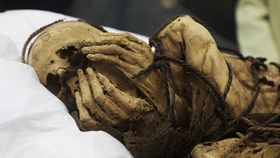


Bound by ropes and appearing to be covering its face in anguish, this perfectly preserved mummy is shedding light on the life and death of cultures that once lay along the mountainous coast of Peru.
The apparently tormented remains were recently discovered in November last year by researchers from the National University of San Marcos at the Cajamarquilla archaeological complex on the outskirts of the Peruvian capital Lima. According to an announcement by the university, the mummy dates to somewhere between 1,200 and 800 years old, a period when this settlement was a bustling hive of trade between the coastal and mountain communities during the late pre-Hispanic period. Their research indicates that this person was a male who died between the ages of 18 and 22 years old. Since they were buried in the middle of where the plaza once stood, they suspect this was a person of relatively high social status or perhaps a merchant.
Still in remarkably good condition, the remains were discovered with ropes tied around the body, cowering in a fetal position with the hands covering their face. They were buried along with the skeletons of a guinea pig and what appears to be a dog inside an underground cone-shaped funerary structure, approximately 3 meters (~10 feet) in length and 1.4 meters (4.5 feet) deep.
While this burial might appear brutal to our modern eyes, archaeologists on the project say it’s not unheard of in pre-Incan mountain-dwelling cultures of present-day southern Peru. It did bring some surprises, however.
Pieter Van Dalen Luna, one of the archaeologists who led the excavation, told CNN that they discovered several marine mollusks outside the tomb of the mummy, which was unexpected considering the site is some 25 kilometers (15 miles) from the coast. There was also evidence of llama bones, a commonly reared animal in Andean cultures.
This, they say, is likely the product of the ongoing nature of pre-Incan funerary practices; bodies were not simply buried and forgotten, but part of a practice that continues long after death.
"After the body is placed in the tomb, there are constant events and activities," Van Dalen Luna explained. "That is to say, their descendants keep coming back over many years and placing food and offerings there, including mollusks."
"The discovery of this resident sheds a new light on interactions and relationships in pre-Hispanic times," he added.