Humans
 PUBLISHED


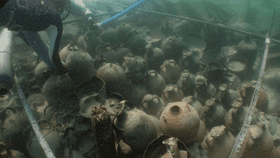


Not far from the tourist-filled beaches of Mallorca in Spain, marine archaeologists have discovered a seabed littered with almost one hundred Roman jugs and a 1,800-year-old shipwreck.
The treasure trove of relics was first discovered in July 2019 in the waters of S'Arenal beach in Palma, according to an announcement from the Council of Majorca.
Given the business of the waters and the value of the remains, authorities were quick to employ the help of the Balearic Institute of Studies in Maritime Archeology (IBEAM) to both document and recover the ancient objects before they were plundered. The marine archaeologists also captured some stunning footage of the shipwreck and the excavation work, which you can check out below.
The merchant ship sank some time during the third century CE while carrying a shipment of supplies from the south of the Iberian Peninsula (aka modern-day mainland Spain) to Rome.
Alongside the shipwreck, the archaeologists counted at least 93 amphorae, the traditional jug with two handles and a narrow neck used by the Greeks and Romans. Now back on dry land, the Council of Majorca has linked up with various specialists who will be responsible for analyzing the content of the amphorae. They will also analyze the ship’s wood and any inscriptions from the wreck to try and piece together more of its story, such as where the traded goods originated from.
Judging by the ship's route and the age of the wreck, they suspect it was carrying olive oil, wine, and a fermented fish gut sauce called garum. Sometimes known as “Rome’s ketchup,” this soy sauce-like condiment was widely popular in ancient times and it’s thought to be the reason why so many people in the Roman Empire were infected with fish tapeworms.
Shortly after their discovery two months ago, Palma police told the local newspaper Majorca Daily Bulletin the wreck holds a “great heritage value” and will eventually be put on display at the Majorca Museum.
“In regards to naval architecture, this wreck is one of the best-preserved in the entire Mediterranean of the lower Roman Empire,” the Council of Majorca’s Culture and Heritage department said.