Ad

space-iconSpace and Physics
clock-iconPUBLISHEDOctober 11, 2014

Wednesday's "Blood Moon" Total Eclipse As Seen From Mercury

Stephen Luntz headshot

Stephen Luntz

Stephen has degrees in science (Physics major) and arts (English Literature and the History and Philosophy of Science), as well as a Graduate Diploma in Science Communication.

Freelance Writer

Stephen has degrees in science (Physics major) and arts (English Literature and the History and Philosophy of Science), as well as a Graduate Diploma in Science Communication.View full profile

Stephen has degrees in science (Physics major) and arts (English Literature and the History and Philosophy of Science), as well as a Graduate Diploma in Science Communication.

View full profile
article image
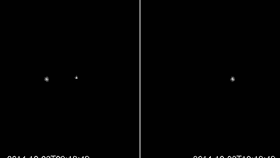
NASA. From Mercury the Earth and Moon are visible just before Wednesday's Eclipse, but the Moon then disappears

Half the world got to see the Moon go red, clouds permitting, on Wednesday, but you didn't need to be on Earth to witness it. The MESSENGER spacecraft turned its camera back towards the Earth and saw the moon slowly fade out of vision as the Earth blocked access to sunlight.

The rest of this article is behind a paywall. Please sign in or subscribe to access the full content.

The MErcury Surface, Space ENvironment, GEochmistry, and Ranging probe has been in orbit around Mercury since March 2011. Having completed mapping of Mercury in 2013, MESSENGER continues to produce results. It follows the publication in 2011 of a “family portrait” of the solar system with images of six planets and five moons.

The eclipse was well timed, with Mercury just eight days from its closest approach to Earth - but that still put it at well over 100 million kilometers away.


Written by 

Add us as a Google preferred source to see more of our
trusted coverage in Search