Health and Medicine
 PUBLISHED


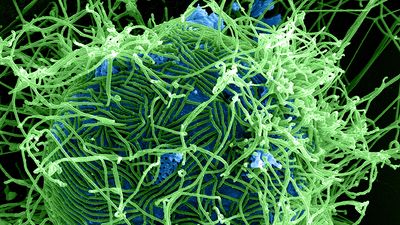


The findings of a new study suggest that the virus behind Ebola – a rare but severe and often fatal illness – may be spread by skin contact, by providing a comprehensive cellular map of its journey to the skin’s surface.
Previous research has identified the presence of the Ebola virus (EBOV) on the surface of the skin during the latter stages of infection, but the details of how it got there were unclear.
To figure out how the virus could be making its way to the skin’s surface, the researchers behind this recent study made use of healthy human skin explants, a type of biopsy that’s removed and cultured specifically for the purposes of research.
In this case, the team used explants that spanned the surface layer (epidermis) of skin through to the middle layer (dermis) and placed them in the culture media dermis side down, then adding Ebola virus particles. The purpose of this was to mimic how the virus particles would move from the blood into the skin in the body.
By also adding tags specific to a plethora of certain cell types and to the viruses, something that had not previously been done, the researchers were able to trace a detailed path of the particles through the layers of the skin.
“The skin is the largest organ in the human body yet is woefully understudied compared to most other organs. Interactions of EBOV with skin cells have not previously been extensively examined,” said Wendy Maury, the study’s senior author, in a statement.
What Maury and colleagues discovered was that the virus particles’ journey was one accompanied by widespread carnage; several different cell types were infected, from those that play a role in the immune system to those responsible for skin healing.
And when it does spread through the skin, it does so quickly – the results showed that the virus particles made their way to the epidermis within three days.
“This study explores the role of the skin as a potential route of Ebola virus infection and identifies, for the first time, several cell types in the skin that are permissive to infection,” said study co-lead Kelly Messingham. “In total, these findings elucidate a mechanism by which EBOV traffics to the skin’s surface and may explain person-to-person transmission via skin contact.”
The team also identified that keratinocytes – the cells that make up the vast majority of our epidermis and play a critical role in its purpose as a barrier – and fibroblasts, which have multiple purposes in the skin, contain specific receptors that let the Ebola virus in, allowing it to spread.
Not only do these results provide us with a greater understanding of another way in which Ebola may spread, but the model used could be a cheap and effective way of finding new treatments too – Maury and colleagues were able to show that existing antivirals were effective at blocking infection in the explants.
“[T]hese routinely disposed of tissues are easily obtained from healthy human donors,” the authors write. “Hence, explant models may serve as excellent intermediate model systems for characterizing antivirals.”
The study is published in Science Advances.



 1
1