Technology
 PUBLISHED
 20
20



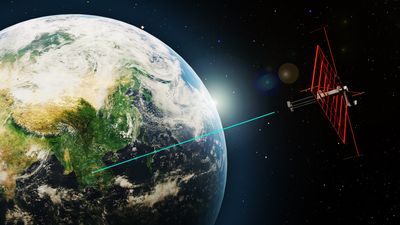


In the video game Simcity 2000, one of the futuristic types of energy plants was a microwave power plant where solar energy was collected in space and transmitted back down to Earth. That idea is now a reality. Since June last year, an experiment in space has been transmitting energy down to Earth via solar panels on a satellite in orbit and now we have the first results of how the experiment is going.
Using their Microwave Array for Power-transfer Low-orbit Experiment (MAPLE), the Space Solar Power Demonstrator (SSPD) has showcased that transmitting power in space and from space to Earth is possible. This is the first time solar power has been transmitted from orbit and could be the first step toward a solar power station in space.
First launched in January 2023, just two months later the device was able to transmit about 100 milliwatts worth of power through space and could easily be refocused to send the beam in any direction. The test sending power to Earth had about 1 milliwatt of power getting to the ground and was conducted three times over eight months.
The idea is to create a modular spacecraft constellation around a kilometer in scale that can transmit enough power to provide for 10,000 homes. Individual 1-meter cube satellites will unfurl into a flat square 50 meters (164 feet) per side with solar cells on one side and microwave transmitters on the other. Because MAPLE can beam energy in any direction, the idea is this approach can directly send energy and power to a remote location or during an emergency as it does not require transmission infrastructure.
"In the same way that the Internet democratized access to information, we hope that wireless energy transfer democratizes access to energy," lead researcher and co-director of SSPP, Ali Hajimiri, said last year.
"No energy transmission infrastructure will be needed on the ground to receive this power. That means we can send energy to remote regions and areas devastated by war or natural disaster."
The SSPD has other components being tested alongside MAPLE: DOLCE (Deployable on-Orbit ultraLight Composite Experiment), which is testing the architecture deployment structure of the spacecraft, and ALBA which is testing the best type of photovoltaic cells to use. Results about them have not been shared yet but they are crucial components for the SSPD.
As this experiment is currently a proof-of-concept, the new preprint paper describing the results highlights some of the weaker areas of the design and where improvements are needed. The next version will build on this one's strengths and get closer to a fully functioning prototype.
The study is awaiting peer review and is available on the ArXiv.
[H/T: New Scientist]