Ad

space-iconSpace and Physicsspace-iconAstronomy
clock-iconPUBLISHEDOctober 26, 2022
share180

Earth and The Moon Look Stunning In New Snap By NASA's Lucy

The flyby allowed Lucy to test instrumentations.

Dr. Alfredo Carpineti headshot

Dr. Alfredo Carpineti

Alfredo has a PhD in Astrophysics and a Master's in Quantum Fields and Fundamental Forces from Imperial College London.

Space & Physics Editor

Alfredo has a PhD in Astrophysics and a Master's in Quantum Fields and Fundamental Forces from Imperial College London.View full profile

Alfredo has a PhD in Astrophysics and a Master's in Quantum Fields and Fundamental Forces from Imperial College London.

View full profile
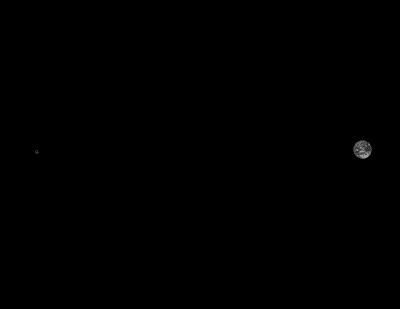
Black and white image of the Moon - Earth system
The Moon and the Earth as Seen by Lucy on October 13. Image Credit: NASA/Goddard/SwRI

NASA’s Lucy is on its way to study Jupiter’s Trojan asteroids but passed by our planet for a “hello again” and a boost. It was the first of three flybys of Earth, which are necessary to send it on the right trajectory, and it took place on October 15.

The rest of this article is behind a paywall. Please sign in or subscribe to access the full content.

As it approached, Lucy captured a few pretty pictures of Earth and the Earth-Moon system using its tracking camera. In the image of the Earth, at the leftmost edge, you can see Ethiopia. 

Lucy is named after the Australopithecus afarensis remains discovered in Hadar, located in the African country. Lucy will be studying multiple objects in the Trojans – asteroids considered fossils of the early Solar System.

Black and white image of Earth centered around the India ocean. East Africa, Saudy arabia, and australia are clearly visible.
Earth as seen by Lucy's Terminal Tracking Camera (T2CAM). Image Credit: NASA/Goddard/SwRI

The photo of the Moon and Earth was taken two days before the flyby and it shows just how far the Moon is from Earth. It was snapped from 1.4 million kilometers (890,000 miles). 

The next flyby will be on December 13, 2024. It will then visit asteroid Donaldjohanson in the Asteroid main belt, as well as the asteroids Eurybates, Polymetes, Leucus, and Orus, which precede Jupiter in its orbit. Lucy will then fly by Earth again on December 26, 2030, before flying to binary asteroids Patroclus-Menoetius in the groups of asteroids that follow Jupiter.

Orbit of Lucy from the frame of reference of Jupiter. Image Credit: NASA


Add us as a Google preferred source to see more of our
trusted coverage in Search