


 Nature
 PUBLISHED
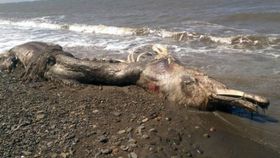


Looking somewhat like an attempted hybridization between Falkor the Luck Dragon from The Neverending Story and a dolphin gone horribly wrong, images of this utterly bizarre creature are spreading though the media like wildfire following its recent discovery in Russia.
As reported by Siberian Times, its long body and extended nose have prompted some to speculate that it could be a Ganges River dolphin, but it seems highly unlikely that a freshwater dolphin could make it all the way from India to Russia and survive in a marine habitat. Not only that, but Ganges River dolphins don’t have fur, nor are they nearly as large as this specimen.
In fact, no dolphin species has fur except shortly after birth, but that hasn’t stopped one expert from “confidently” asserting that it is indeed some kind of dolphin.
“Judging by the appearance of the head, this is clearly some big dolphin,” said Nikolay Kim from the Sakhalin Research Institute of Fisheries and Oceanography. “According to the characteristic of the skin, it is a rare species.
“I doubt that it lived in our waters. Most likely, the animal was brought by the warm current. Here often appear tropical and subtropical species. On cooling, they stay here and then die.”
If it is indeed some kind of dolphin, the fur issue may be resolved by an idea put forward by David Smith, Professor of Marine Biology at Essex University. He suggested to the MailOnline that its hair-like covering may actually be some kind of filamentous algae. Alternatively, Smith suggests, it could actually be an ancient species that until now had been preserved in permafrost, perhaps even a mammoth. Warming temperatures could have defrosted the animal, and a crumbling cliff could have led to it being deposited into the ocean. While it may look nothing like a mammoth, Smith isn’t the only one to put forward this proposal, as Oxford University’s Professor Alex Rogers also believes this is a possibility.
Center and bottom image credit: SakhalinMedia



 1
1