Nature
 PUBLISHED



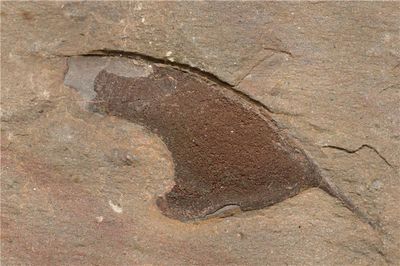


For the first time, chitin has been identified in a Cambrian Period trilobite. The unexpected discovery could be useful for palaeontologists’ understanding of invertebrates, and it also suggests this abundant organic polymer may have a more complex role in the carbon cycle than scientists thought.
Today, chitin (C8H13O5N)n is the second most common organic polymer on Earth behind cellulose. It’s most familiar to many as the basis for crab shells, but it is also widely used by fungi and by insects for protection. Industrial chemists are working hard to find ways in which it can be used as a more environmentally friendly replacement for plastics.
A team led by Dr Elizabeth Bailey of the University of Texas, San Antonio, found chitin in an Olenellus trilobite fossil in 514-506 million-year-old shale at Emigrant Pass, California. After all that time, it wasn't easy to detect, but a combination of infrared and mass spectroscopy and fluorescent staining revealed the presence of d-glucosamine, the molecule that joins up to make chitin.
The diversity of chitin-producing animals indicates its roots are very ancient, so it isn't surprising that trilobites made it during the Cambrian Period. Finding proof is much more unexpected, however, because chitin was thought to break down far quicker than this, although a few recent studies challenged that idea. Moreover, while trilobites seemed likely candidates for chitin production, given their suspected relationship to species that make it today, no one knew for sure.
“This study adds to growing evidence that chitin survives far longer in the geologic record than originally realized,” Bailey said in a statement. “Beyond paleontology, this has significant implications for understanding how organic carbon is stored in Earth’s crust over geologic time.”
The preservation of vast amounts of cellulose and lignin as coal changed Earth’s environment, until we started burning it and returning carbon dioxide to the atmosphere and oceans. Similarly, vast quantities of carbon are locked up in limestone formed from ancient shells, as well as chitin-producing organisms.
“When people think about carbon sequestration, they tend to think about trees,” Bailey said. However, she added: “Evidence that chitin can survive for hundreds of millions of years shows that limestones are part of long-term carbon sequestration and relevant to understanding Earth’s carbon dioxide levels.”
Although the trilobite was in a fossil-rich bed, Bailey and co-authors point out that it was “far from pristine”, indicating circumstances don’t need to be perfect for chitin to survive this long.
The authors also say there is a possibility that chitin survives better “When incorporated into hardened structures, including structures reinforced with calcium carbonate.”
Bailey came to this collaboration from an unusual angle, having previously published work on planetary dynamics, bolstering the search for Planet Nine.
“I was motivated to pursue this work from my perspective as a planetary scientist interested in how organic molecules play a role in planetary geochemical processes,” Bailey said. “My collaborators specialize in modern chitin analytics, and they were excited to apply increasingly sensitive techniques to such an ancient and iconic fossil group.”
The study is published in PALAIOS.