Humans
 PUBLISHED
 6
6


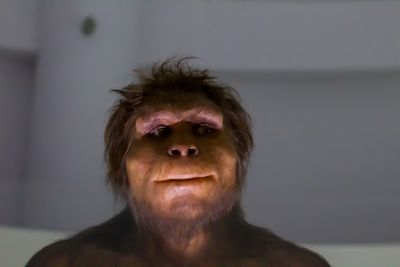


Of all the traits that set humans apart from the rest of the animal kingdom, language is arguably the most significant. Despite this, we still don’t know when the unique ability for symbolic verbal communication arose, although the authors of a new study suggest that one of our extinct ancestors may have already possessed the gift of the gab 2 million years ago.
Homo erectus, the researchers say, possessed all the tools necessary for speech and language, building their argument around various lines of anatomical, genetic, and archaeological evidence. For instance, they explain that “Homo erectus was the first Homo species to have a greatly expanded brain”, adding that certain key regions like the frontal and parietal lobes were morphologically similar to those of modern humans.
Of course, this in itself does not prove that H. erectus could talk like us, but the study authors indicate that the species was sufficiently cognitively advanced to have used language. They also address prior concerns that archaic hominins were incapable of the advanced breathing control required for speech due to a narrow spinal canal, by highlighting that some Homo erectus specimens have been found with a spinal cord that falls within the range seen in Homo sapiens.
Again, this doesn’t prove anything, and scholars have contested whether this anatomical feature can even be used as a predictor of speech capabilities. Yet the researchers don’t stop there, and go on to point out that the inner ear structure of some Homo erectus populations may also have been ideal for hearing the spoken word.
On top of all that, they write that “genetically, many important mutations related to brain, cognition, and language could be traced back to the time of Homo erectus.” For instance, a gene called FOXP2 is believed to be linked to the emergence of vocal communication, yet also plays a role in bipedal locomotion. Given that Homo erectus walked on two feet, the study authors suggest that the species may have possessed this genetic blueprint for language development.
Finally, the researchers note that Homo erectus used stone tools representing the Acheulean industry rather than the more archaic Oldowan toolkit. The ability to conceptualize, learn, and teach the techniques required for producing these more advanced utensils may have required both abstract thought and symbolic communication, providing yet another hint of the linguistic capacity of Homo erectus.
In an email to IFLScience, study author Lan Yao from China Jiliang University explained that “the possibility [that Homo erectus spoke] is relatively high despite no 100 percent certainty due to the inferential nature of research on language origin.”
Such a claim is unlikely to go unchallenged, however, and the idea of Homo erectus having language has previously been disputed. For instance, evidence that the species navigated the ocean in order to reach the islands of Indonesia has been used to argue that this prehistoric hominin possessed the ability for complex communication and cooperation, yet other scholars have dismissed this theory.
Similar arguments have been built around the fact that Homo erectus may have hunted and scavenged in “gangs”, yet these too have been strongly opposed.
At present, there’s no consensus on which human species was the first to talk, although many anthropologists believe that Neanderthals had some kind of language. The most compelling evidence for this hypothesis comes from the fact that Homo sapiens and Neanderthals mated, producing hybrid offspring that survived and thrived, eventually becoming our ancestors.
It’s highly likely, therefore, that these prehistoric love children were capable of speech, which means both parents probably also had language.
Intriguingly, however, the authors of the new study discuss genomic data that suggests that the Denisovans – our closest human relatives – appear to have had a similar romantic relationship with an unknown archaic hominin, widely suspected to be Homo erectus. This evidence provides the pièce de résistance for their argument that Homo erectus possessed a spoken language, although dissenting scholars are unlikely to bite their tongues when answering back.
The study is published in the journal Biological Theory.