Space and Physics
 PUBLISHED
 1
1


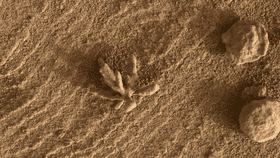


When you're a busy rover with the ground to cover and important science to carry out, it's not often you have time to stop and smell the roses – that and flowers are few and far between on other worlds. That didn't stop Curiosity from spotting a curious flower-like object on the Martian surface and snapping a picture to send to the folks back home.
According to NASA scientists, the flower-like rock is smaller than a penny and it – plus the two round rocks accompanying it – were likely formed millions of years ago by the Red Planet's watery past.

The branching mineral deposit, resembling a piece of coral as much as a flower, is just 1 centimeter (0.4 inches) tall. Found on the slopes of Mount Sharp in Gale Crater, where Curiosity has been exploring since 2012, the image is a composite made up of multiple shots using the rover's Mars Hand Lens Imager, which takes close-ups using its magnifying lens.
Spotting Earth-like things on Mars is a popular hobby, though the likelihood of gorillas and mice populating another world without our knowledge is unlikely. However, Mars doesn't need any extra help providing fascinating objects to study.
Yes, its robotic scientists may send back a lot of pictures of rocks, but those rocks – ranging from mysterious purple coated to green to hiding ancient water and even sneakily hitching rides – provide us with insights into Mars's history, its make-up, and sheds light on the ultimate question: has there ever been, or could there ever be, life on Mars?