Space and Physics
 PUBLISHED
 1
1



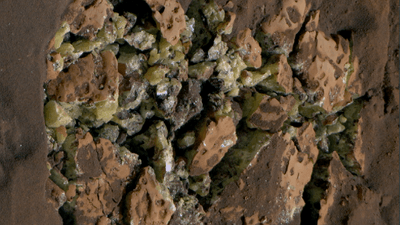


For the last 10 months, NASA’s curiosity has been investigating a region of Mount Sharp that is of high interest. It has signs of a violent watery past and chemical analysis has revealed the presence of many minerals including sulfates. As the rover moved about it accidentally cracked open a rock, and inside it saw pure sulfur crystals. Pure sulfur had never been seen before on Mars.
While sulfates have sulfur, there is not a clear relationship between the formation of those molecules and the pure crystals. Elemental sulfur crystals form only in a narrow range of conditions. And none of those have been expected for this region.
“Finding a field of stones made of pure sulfur is like finding an oasis in the desert,” Curiosity’s project scientist, Ashwin Vasavada of NASA’s Jet Propulsion Laboratory, said in a statement. “It shouldn’t be there, so now we have to explain it. Discovering strange and unexpected things is what makes planetary exploration so exciting.”
The region Curiosity is exploring is known as the Gediz Vallis channel. It is a groove across Mount Sharp that has been an area of interest since long before the rover began climbing the relief in 2014. From orbit, scientists could see the presence of large mounds of debris. But the cause of them was not apparent. Was it landslides or ancient floodwaters that shifted the material along the channel?
Curiosity has been able to provide an answer. A bit of column A and a bit of column B. Rocks shifted by water are smoother and rounded. Those shifted by dry avalanches are angular and sharp. Both types of rocks are found among the mounds.
“This was not a quiet period on Mars,” said Becky Williams, a scientist with the Planetary Science Institute in Tucson, Arizona, and the deputy principal investigator of Curiosity’s Mast Camera, or Mastcam. “There was an exciting amount of activity here. We’re looking at multiple flows down the channel, including energetic floods and boulder-rich flows.”
Curiosity continues to investigate the Gediz Valley. When even just rolling about revealing unique features, we can be very excited about the science that is being pursued here.