Humans
 PUBLISHED


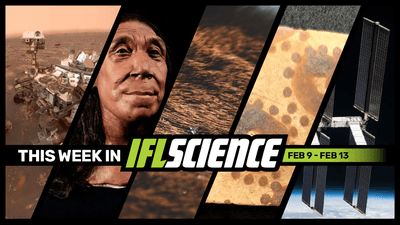


This week, a new theory suggests the extinction of Neanderthals may have been in part a result of their complicated pregnancies, the world’s earliest mathematical thinking may have just been revealed in the oldest botanical art, and what if, instead of crashing the ISS back down to Earth, we turned it into a space museum? Finally, there’s a radical new plan to build an 80-kilometer wall around Antarctica’s “Doomsday Glacier”.
Create an IFLScience account to get all the biggest science news delivered straight to your inbox every Wednesday and Saturday.
Curiosity May Have Just Found Second-Best Proof That Mars Once Had Life
Organic molecules found by the Curiosity rover are too common to be explained by any process we know, other than life, according to a new study. That, of course, doesn’t rule out the possibility that some unknown process was responsible, but it marks the second sample where ancient life is now the most obvious answer to the measured composition. Read the full story here
Neanderthal Pregnancies May Have Been More Complicated Than Ours, Contributing To Their Extinction
We still don’t fully understand why Neanderthals became extinct while our species thrived, although low fertility rates are believed to have played a role in the demise of our prehistoric cousins. The reasons for these reproductive failures are likely to be varied, yet a new theory suggests that high rates of fatal pregnancy complications may have been a major culprit. Read the full story here
These Tiny, Unremarkable-Looking Scraps Of Elk Hide May Be Oldest Sewn Clothing Ever Found
Two unassuming fragments of elk hide have been found in a cave in what is now Oregon that show evidence of being sewn. This makes them the earliest known evidence of sewn hides likely used as clothing, beating the previous record by 9,000 years. It confirms something we’ve long supposed, but so far never been able to prove: how our ancient ancestors coped, all those years ago, with the bitter cold of a world in the grip of the Younger Dryas. Read the full story here
World’s Oldest Botanical Art Just Revealed The World's Earliest Mathematical Thinking
Ancient pots decorated with a dainty floral pattern may be hiding a much deeper secret: the origins of mathematical thought. And, as it turns out, it dates back a lot further than we previously thought, predating both numbers and writing. Read the full story here
What If We Don’t Crash The ISS Back Down, And Turn It Into A Space Museum Instead?
For over 25 years, there has not been a moment when all humans were together on planet Earth, and that’s thanks to the International Space Station (ISS), traveling over 400 kilometers above Earth. This spacelab has been a symbol of cooperation, a place for advanced scientific investigations, and a home for long-duration forays into space. In five years, it will come crashing through the atmosphere in a controlled deorbit as it comes to an end. If we could save it, should we? Two lawmakers think that NASA should at the very least consider it. Read the full story here
TWIS is published weekly on our Linkedin page, join us there for even more content.
Feature of the week:
The Radical Plan To Build An 80-Kilometer Wall Around The "Doomsday Glacier" Of Antarctica
The “Doomsday Glacier” earned its nickname for a reason. Officially known as the Thwaites Glacier, this massive body of Antarctic ice is nearing a tipping point. If it entirely collapses, this single glacier alone could release enough water to raise global sea levels by 65 centimeters (over 2 feet), contributing to a catastrophe that would swamp coastal cities and swallow island nations. But one bold project has an extraordinarily ambitious solution to keep that threat at bay: building a giant sea curtain on the seafloor off Antarctica. So, we asked them, what's the plan? Read the full story here
More content:
Have you seen our e-magazine, CURIOUS? Issue 43, February 2026, is available now. This month, we asked, “Why Do We Need The Dark?” – check it out for exclusive interviews, book excerpts, long reads, and more.
PLUS, the We Have Questions podcast – an audio version of our coveted CURIOUS e-magazine column – continues. In episode 17, we ask, “How Can Swimming For 37 Hours Help Tackle Ocean Plastic?”
The Big Questions podcast season 5 has now concluded, but here’s one more bonus episode to help see you into 2026: Can Magic Be Used As A Tool In Science? You can catch up on the whole of season 5 here.