Space and Physics
 PUBLISHED
 25
25


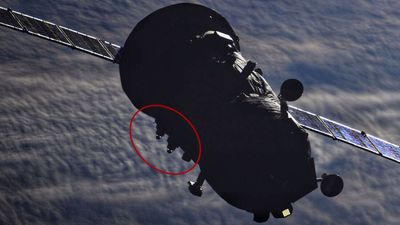


Has the Fermi Paradox finally been answered and intelligent life has, at last, got in contact? Not quite, but as a resident of the International Space Station (ISS), staring out the window into the cosmos doesn't often feature two sets of "eyes" staring back.
What do you do? You immediately head to Twitter.
"Progress MS-18 successfully undocked and departed," cosmonaut Sergey Korsakov tweeted after watching the Russian cargo craft leave the space station and head home. "But who are those stowaways watching us?"
Who indeed?
Twitter's response ranged from Dr Who's Daleks to Star Wars' R2D2 and Jawas. We're throwing in the Iron Giant, just on a slightly smaller scale, too.
Korsakov also shared a close-up of the beady-eyed onlookers, which are, of course, just components of the outside of the cargo craft catching the light. The craft had been resupplying the ISS, including fuel, research equipment, oxygen, water, and food, but that's not its only job. The automatic spacecraft is also used to correct the ISS's orbit – whether that is helping the ISS jump out of the way of ever-increasing space junk or reboosting the space station when it starts to drag – by firing its thrusters when docked.
Known to NASA as ISS Progress 79, the craft, which has been docked at the ISS for 214 days, removed 1.3 tonnes of garbage, end-of-life equipment, and debris, cosmonaut Oleg Artemyev told Russian state newspaper TASS. Job done, it burned up in Earth's atmosphere on return in a fiery demise above the Pacific Ocean.
RIP little space droids, we hardly knew you.