Space and Physics
 PUBLISHED
 1
1



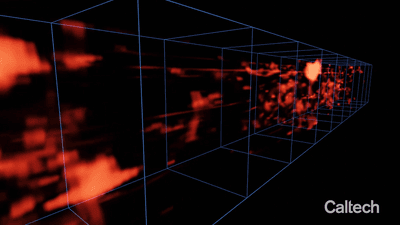


Every galaxy and cluster of galaxies is connected to the others by the cosmic web. Streams of gas stretch across the universe, where the most massive clusters form nodes. The structure is extremely faint and everything known about it comes from using quasars as a light source. The gas in the cosmic web filters some of the light, and astronomers can study it. Now, they have been able to see without any illumination.
“Before this latest finding, we saw the filamentary structures under the equivalent of a lamppost,” lead author Professor Christopher Martin, from Caltech, said in a statement. “Now we can see them without a lamp.”
The achievement was possible thanks to the Keck Cosmic Web Imager, or KCWI, designed by Martin. It is installed on the W. M. Keck Observatory atop Maunakea in Hawaiʻi. The instrument measures the presence of neutral hydrogen, the main component of the cosmic web. In particular, it looks for the soft glow of excited hydrogen, through a specific wavelength called the Lyman Alpha line.
Due to the expansion of the universe, the value of this wavelength is shifted towards the red portion of the light spectrum for objects that are further away. So by measuring many different Lyman alpha emissions at different wavelengths, the team can not only work out the shape of the cosmic web in two dimensions but also how far that emission is coming from.
“We are basically creating a 3D map of the cosmic web,” Martin explained. “We take spectra for every point in an image at a range of wavelengths, and the wavelengths translate to distance.”
Understanding the structures of the cosmic web is very important for our understanding of the universe as a whole. The structure feeds galaxies with gas, influencing their evolution. It also helps them understand how dark matter behaves. This is the hypothetical substance believed to surround all galaxies (making up 85 percent of all matter in the universe). It only interacts through gravity so you need big massive structures to guess how it is distributed.
“The cosmic web delineates the architecture of our universe,” Martin said. “It’s where most of the normal, or baryonic, matter in our galaxy resides and directly traces the location of dark matter.”
The study is published in Nature Astronomy.