Space and Physics
 PUBLISHED
 3
3



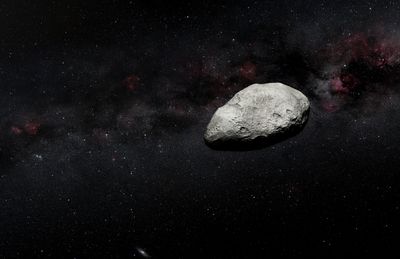


Valentine’s Day is almost upon us and this year, it comes with a potentially hazardous asteroid. Do not worry, it is not gonna ruin anyone’s plans with country destruction but if you need an excuse to get out of some plans, saying that you are watching an asteroid is a pretty good one in our opinion.
The rock in question is called 2024 BR4. As the moniker indicates, it was discovered this year. Just a few weeks ago, as it was about 12 million kilometers (7.5 million miles) from our planet. The Catalina automatic survey was responsible for the first observation on January 30, 2024.
The object is classified as potentially dangerous and for good reason. The size is estimated to be between 100 and 300 meters (330 to 990 feet), and an object this wide hitting the planet could cause incredible devastation under the right conditions. Asteroids are complicated, so it’s not just about the size but also the composition and where on the planet it hits.
For this object, we know very little. The size for example is very approximate. NASA’s Small-Body Database gives an absolute magnitude for the object of 21.4 – that’s how bright it is. The bigger the object the brighter it appears. But to make the best estimation with that parameter you also need the albedo – the fraction of reflected light by the surface. That is currently not available so the uncertainty we can calculate is fairly wide.
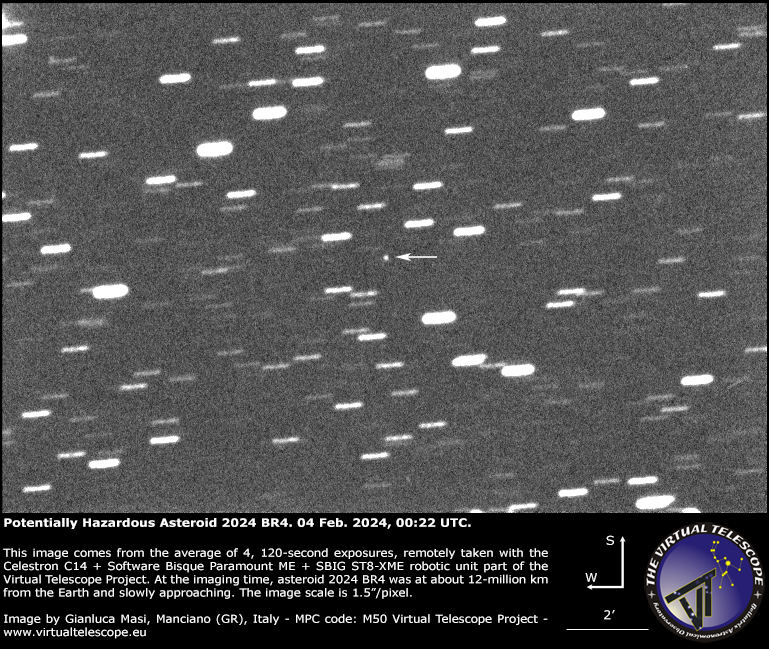
Still, this is probably one of the 14,000 "city-killer" asteroids that are left to find. And it’s not coming close to us for a long time. Because, despite size uncertainties, astronomers have worked out its orbit very well. On Valentine’s Day, it will be no closer than 4.6 million kilometers (2.86 million miles). That’s 12 times the average distance of the Moon.
To continue the good news streak, Wednesday’s flyby will be the closest this dangerous object gets to our planet in the next 120 years. The detection also shows how far surveys have come in the last few years. The asteroid flew past Earth at 14 lunar distances in 2011 but it went completely undetected. Now we know that it is out there and we are safe from it for a very long time.