


 Humans
 PUBLISHED


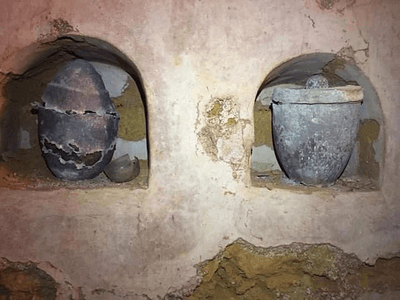


In Roman Spain, some 2,000 years ago, people may have been perfuming themselves with the musky scent of patchouli, new research hints. The study marks the first time that the composition of a Roman perfume has been identified, offering us a rare whiff of a bygone empire.
The perfume, which has solidified after two millennia inside a carved quartz bottle, was discovered in a funerary urn found in a mausoleum in Seville, Spain. Unearthed in 2019, during an excavation in modern-day Carmona, the mystery ointment has now been chemically described, revealing the inclusion of patchouli, an essential oil common in modern perfumery but never before known in use in ancient Rome.
As well as the essence of patchouli, obtained from Pogostemon cablin, a plant of Indian origin, the cologne was found to have a base of vegetable oil – possibly olive oil – although the researchers cannot be certain about this.
The vial in which it was found was made of rock crystal (quartz) carved in the shape of an amphora, which would have been exceptionally rare and expensive – perfume containers were typically made of blown glass back in the first century CE.

“In Roman times, quartz vessels were very rare luxury objects several of which have been found near Carmona,” the team write in a paper on their findings. “The [jar] was thus a rather unusual finding for an archaeological site, and even more unusual is that it was tightly stopped and contained a solid mass.”
It is the very fact that the flask was so perfectly sealed, with a type of carbonate mineral called dolomite as a stopper and a bitumen seal, that means the solidified perfume inside has been so well preserved.
Alongside the unusual vessel were three amber beads, held in a cloth bag. This trove of treasured artifacts was found inside a glass urn with the cremated remains of a 30-to-40-year-old woman. Five other urns had been buried in the tomb, containing the remains of an affluent family, the researchers believe.
To decipher the fragrance’s composition, the team used techniques including X-ray diffraction and gas chromatography coupled with mass spectrometry to identify notes of patchouli. This, they believe, is the first time a perfume from Roman times has been identified.
“Although archaeological excavations have recovered a large number of vessels used to hold perfumes or ointments in ancient Rome, little is known about the chemical composition or origin of the substances they contained,” they write, which makes their discovery all the more exciting.
Romans had quite a penchant for perfumery, it turns out, using fragrances “not only in daily life but also on special occasions such as funerals, where incense was mandatory. In addition, perfumes were applied as ointments or used to embalm the deceased.”
It wasn’t just Romans experimenting with scent. Last year, we found out that Cleopatra may have been partial to a spicy bouquet. Perhaps Julius Caesar and Mark Antony doused themselves in patchouli so as not to be out-smelled.
The study is published in the journal Heritage.




 1
1