Space and Physics
 PUBLISHED



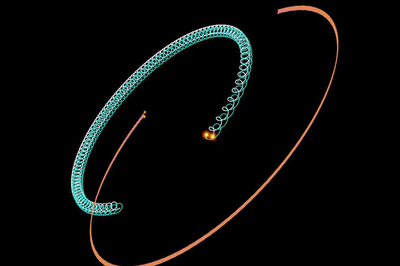


It is definitely a month for eclipse-related excitement. In addition to a recent solar eclipse and upcoming lunar eclipse, astronomers have discovered a system of four stars that produces a peculiar set of mutual eclipses.
NASA’s planet-hunting space telescope TESS (Transiting Exoplanet Survey Satellite) is designed to see stellar eclipses to spot exoplanets. It's called the transit method. If there is a planet around a star and it passes between that star and Earth, TESS would spot a little dip in light, where the planet blocks it.
The method also works for spotting binary star systems in which one star in the pair passes in front of the other, "eclipsing" it from the point of view of Earth.
That's already exciting, but what's going on at TIC 433545934 is even more special: the system is a type 2+2, so there are four stars in two pairs, and the pairs orbit each other. Viewed from Earth, each star can eclipse its partner – causing the amount of light measured to change quite significantly.
On top of that, one of the pairs, which the astronomers behind this work call pair B, also eclipses both members of pair A. Due to the orbital parameter of the system, from our point of view, pair A is never in front of pair B, and so this "mutual" eclipse never happens the other way round. This is the first confirmed doubly eclipsing binary with a mutual eclipse.
The stars of pair A orbit around one another every 2 days, and each star is between 2.2 and 2.4 times the mass of our Sun. Pair B goes around a little faster, orbiting every 1.4 days, and is composed of one star of similar size to the members of the first pair and another 1.3 times the mass of our Sun.
The two pairs orbit each other every 224.5 days, which makes it the fifth most compact 2+2 quadruple system we know of. The most compact 3+1 quadruple system was only discovered a few months ago, and it was also a TESS object of interest.
The whole system is young, about 580 million years old. Due to their masses, though, the stars are already swelling up into their next phase of their stellar life. The team estimates that in about 152 million years, the three larger stars will have expanded into their Roche’s lobe and begun to overflow.
A Roche lobe is the teardrop region that forms when the material from an expanding star in a binary system is pulled by the gravity of the companion. The lobe is located where the gravity of the two objects cancels out; material beyond that point will flow from one object to the other.
Roche-lobe overflow is responsible for many extreme astronomical phenomena, such as cataclysmic variables, type Ia supernovae, and X-ray binary systems. So this quadruple star system, majestic as it is, isn't meant to last forever, and it might go on to give rise to a particularly unusual type of supernova.
A paper describing the discovery is accepted for publication in Astronomy & Astrophysics, and it is available on the ArXiv.
[h/t: Phys.org]