


 Health and Medicine
 PUBLISHED


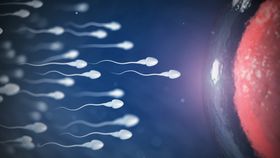


The Mission to Egg is one of the longest-standing races of all time. In human reproduction, when sperm meets the cervical mucus the race is on to be the first to make it to an unfertilized egg, which will close itself off to runners up once the winner has made contact. As such, genetic information passed on by a male is competing with itself as well as other males to be carried into the next generation. We are still learning much about how this fraught journey is made (turns out sperm swim more like an otter than an eel) and new research published in the journal Science has discovered a previously unknown mechanism through which some sperm behave in their own self-interest instead of the health of the overall organism.
Sperm are sex cells, known as gametes, and they carry half of the genetic material needed to create an embryo of a specific species. It was once thought that sperm cells evenly shared gene products through cytoplasmic bridges, which essentially leveled the playing field making all sperm in a semen sample roughly the same. However, this new research has found that a surprisingly large group of mammalian genes actually aren’t shared across these bridges. The significance of this discovery is that it contradicts previous assumptions that all sperm cells must be functionally equivalent, meaning they have roughly the same odds of reaching the egg first.
To reach this conclusion, the team compared the ratio of specific alleles (all the variations of one gene, eg brown, blue, or green eye color) in more than 12,000 genes. Of the samples they investigated, it became clear that some sperm weren’t sharing their gene variants with their contemporaries, and they labeled these geoinformative markers (GIMS).
“Sperm that have functional differences due to GIMs could lead to a ‘selfish gene’ effect,” explained co-author on the study Robin Friedman in an interview with Inverse. "Alleles spread through a population quickly because they help sperm compete, but not because they help the entire organism survive overall."
If this seems like a lot of gene-talk mumbo-jumbo right now, it might be easier to paint the study’s significance by referring to one of genetic inheritance’s most famous poster boys: Gregor Mendel. For those unfamiliar with the name, Mendel was famously mad for peas. The Austrian monk worked tirelessly in his garden observing how crossbreeding plants influenced the height, pod shape, and color of their offspring. His law of segregation informed our (seemingly incorrect) understanding that when two parents reproduce their alleles will be randomly distributed in their offspring.
This new understanding debunks that, as it demonstrates that the inheritance of alleles is not always random and that these types of sperm cells are far more common than previously thought, though they still represent the overwhelming minority. The researchers posit that the effect of GIMs might be subtle, but that they exist is a plot twist in the tale of mammalian reproduction and inheritance.
[H/T: Inverse]

 1
1