Culture and Society
 PUBLISHED





When it comes to world building, some authors really put the effort in. In a new study, climate scientists attempted to model the environments of Westeros and Middle Earth – from A Song of Ice and Fire and The Lord of the Rings, respectively – showing that these worlds are surprisingly well built, and plausible despite the fantasy settings.
In terms of modeling, Middle Earth was a little easier. Tolkien essentially wanted it to be a mythical version of Earth at some point in the ancient past, meaning that the team could start with models of the Earth/Sun in their usual setup.
When they simulated the climate, working with Tolkien's descriptions as well as handy maps, they found it was similar to Western Europe and North Africa.
"The highest precipitation fell on and to the west of the Misty Mountains, with a drier 'rain-shadow' effect to the east. This effect is caused by prevailing westerly winds forcing moist air to rise and cool over the mountains, condensing water vapour into rain or snow before it reaches the eastern side," the authors explain in a piece for The Conversation.
"The model’s prediction of extensive forest cover across much of Middle-earth was consistent with Elrond’s claim that in the past, squirrels could travel from the Shire to Dunland without touching the ground."
Mordor, meanwhile, was found to be a dry, sub-tropical region similar to the Sahara desert.
Westeros's seasons are a little more difficult to explain, and we're not talking about season 8. In A Song of Ice and Fire, the books on which the Game of Thrones TV series is based, the world has long winter and summer seasons. As well as being long, with some seasons lasting generations or decades, they are unpredictable.
In a stable orbit like ours, you don't get these wild variations of seasons. So in the past, scientists have attempted to model what kind of planet-sun system could result in the unique climate of A Song of Ice and Fire. One previous team suggested that it could be explained if Westeros were on a planet circling a binary star system – sort of like the Three Body Problem (or A Remembrance of Earth's Past, for fans of the books) but with popsicle zombies instead of total annihilation of civilization on the planet.
"By speculating that the planet under scrutiny is orbiting a pair of stars, we utilize the power of numerical three-body dynamics to predict that, unfortunately, it is not possible to predict either the length, or the severity of any coming winter," that team wrote in their 2013 study.
"We conclude that, alas, the Maesters were right – one can only throw their hands in the air in frustration and, defeated by non-analytic solutions, mumble "Coming winter? May be long and nasty (~850 days, T<268K) or may be short and sweet (~600 days, T~273K). Who knows..."
Alternatives place Westeros in a four body system or on a moon orbiting a gas giant to deal with the problem. In the new study, the authors took a different approach. They modeled Westeros as taking place on a planet with a chaotically varying axial tilt, tumbling throughout the planet's year like a spinning top. According to the team, if a tumble took place on every journey around its host star, it would result in one hemisphere being in permanent summer, and the other in permanent winter.
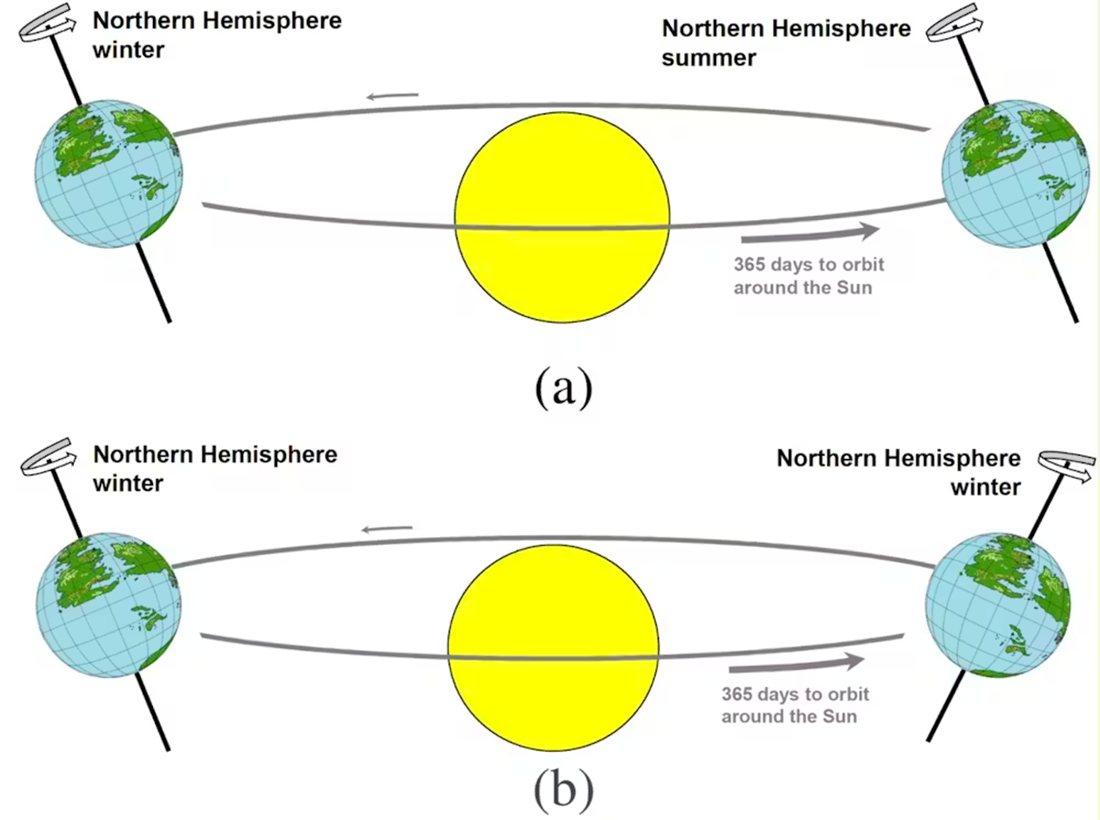
According to the team, the whole of Westeros could be considered Northerners, with permanent winter only being plausible at higher latitudes. The Lannisters would not be too happy about that.
To create changing seasons, where winter can plausibly be coming, the planet must flip every few years.
"The reason for this flip is unclear," the team writes in their paper, explaining that the Earth's tilt is stabilized by our Moon, and without it we may experience unpredictable seasons too.
"Could a similar phenomenon explain the seasons of Westeros? The world has one moon but according to legend, used to have a second moon until it 'wandered too close to the sun and it cracked from the heat'. Might the loss of a second moon have caused a chaotically tilting axis? This question seems suited for the astronomy community to explore."
So, why conduct the study in the first place? Are we going to try and solve Jon Snow's climate problems, freeing up more time for him to mope?
"Ultimately, applying physics to fictional lands provides an engaging way to connect general audiences with complex environmental science," the authors explained.
"By using climate models, scientists honour Tolkien’s demand that even the most fantastical worlds must maintain a credible, finely-tuned balance between the familiar laws of realism and the fantastic."
The study is published in Fafnir - Nordic Journal of Science Fiction and Fantasy Research.