Humans
 PUBLISHED


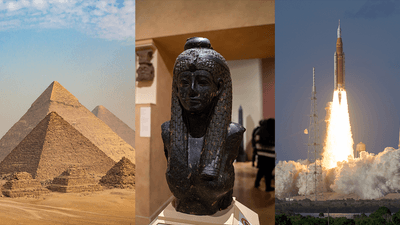


We all know the pyramids are old, but rarely do we comprehend just how old. They’re ancient Egyptian, right? They’re from A Long Time Ago – just like King Tut or Cleopatra.
Well, no. Cleopatra may be one of the most famous pharaohs of Egypt, but she lived from about 70 BCE to 30 BCE – that is, at the same time as the Romans. Not the early Romans, either: her 21 years on the throne – or, since this is Ancient Egypt, perhaps “behind the beard” is more fitting – saw the rise of Julius Caesar and the decline of the Roman Republic, and only just missed the official formation of the Empire in 27 BCE.
The pyramids at Giza, on the other hand, were built during the Fourth Dynasty of the Old Kingdom – or, in modern terms, between around 2600 and 2500 BCE, a few decades after the earliest-known pyramid in the whole country, the Pyramid of Djoser. At that time, woolly mammoths were still wandering around up in the Arctic; it was so long ago that people hadn’t yet figured out iron smithing, and Stonehenge was barely half-finished over in England.
Work out the math on that timeline, and you come to an unexpected conclusion: that Cleopatra lived closer to us today than she did to the construction of the pyramids. To her, they were already ancient – as old to her as, say, the Nazca Lines are to modern Peruvians.
“By Cleopatra's time, the Pyramids of Giza were famous far beyond Egypt, and were highlights of a well-established tourist circuit,” pointed out Garrett Ryan, a historian, YouTuber, and author of three books on Roman and Greek history, back in 2021. “They still had most of their casing stones – those would be stripped after being loosened by medieval earthquakes – though they appear to have been in less than pristine shape by the first century CE[.]”
“It is all but certain that [Cleopatra] visited, most famously when she voyaged up the Nile with Caesar and a flotilla of 400 boats,” Ryan added. “There is no explicit mention of her stopping to admire the pyramids, but it would have been surprising if she did not. The Egyptian priesthood was still a vibrant force in her time, as it would be for centuries.”
As much as they’re both Egyptian, then, Cleopatra is closer to today’s Mo Salah or Mena Massoud than she was to the nameless workers who built the Giza complex. She is, as a popular meme says, closer in time to the Moon landings than the pyramids.
It’s a strange fact, and one that forces us to reconsider how we think of “ancient history” – not as one giant monolith, but a long period of time throughout which a whole lot changed and evolved.
And then, once we’ve sorted that out in our heads, maybe we can start to grapple with the whole “T. rex lived closer in time to us than to Stegosaurus” thing. It’s all, in the end, a matter of scales.