Space and Physics
 PUBLISHED


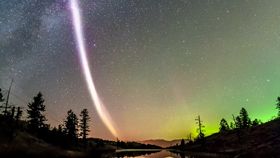


A new atmospheric phenomenon related to Northern Lights has been discovered, thanks to the crucial help of citizen scientists. It appears as a purple streak across the sky and has been given the moniker of… Steve.
Steve was originally nicknamed “proton arc” by the Alberta Aurora Chasers, but it turns out not to be caused by protons. The amateur group showed pictures of it to Professor Eric Donovan from the University of Calgary, who said it was a previously undiscovered feature. Since nobody knew what it was, they went with Steve.
To learn more about Steve, the Alberta Aurora Chasers combed through their incredible database of images, while Donovan and colleagues used the European Space Agency Swarm Satellite.
“As the satellite flew straight though Steve, data from the electric field instrument showed very clear changes. The temperature 300 km (186 mi) above Earth’s surface jumped by 3000°C and the data revealed a 25 km-wide (15-mi-wide) ribbon of gas flowing westwards at about 6 km/s (3.7 mi/s) compared to a speed of about 10 m/s either side of the ribbon,” Professor Donovan said in a statement. “It turns out that Steve is actually remarkably common, but we hadn’t noticed it before. It’s thanks to ground-based observations, satellites, today’s explosion of access to data and an army of citizen scientists joining forces to document it."
Donovan and other scientists working with Swarm agree on the importance of the many talented photographers and amateur astrophiles for bringing Steve to the attention of scientists.
“It is amazing how a beautiful natural phenomenon, seen by observant citizens, can trigger scientists’ curiosity,” Swarm Mission scientist Roger Haagmans added. “The ground network and the electric and magnetic field measurements made by Swarm are great tools that can be used to better understand Steve. This is a nice example of society for science.”
 Steve in all its glory. Dave Markel Photography