Space and Physics
 PUBLISHED
 1
1



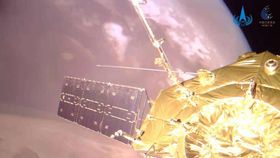


Earlier this month, China's Mars orbiter, Tianwen-1, amazed us by revealing it had launched in orbit a small camera device to take a "selfie" of itself above the Red Planet. Now it has revealed something unexpected again. The spacecraft is equipped with a camera at the end of an extendable arm, which has filmed Tianwen-1 as it speeds across the surface of Mars.
The release of the video is set to mark the Lunar New Year, which is celebrated from tonight, in the many East and Southeast Asian countries that employ the lunar calendar.
The video, shared on the Chinese social network Weixin (WeChat) by the Chinese National Space Administration, shows the orbiter moving across the dark sky, readjusting its solar panel, and then bam, the surface of Mars rolls into view and you realize it's flying just a few hundred kilometers above the Red Planet, its North Pole and glaciers clearly visible against the redness of the surrounding soil.
The selfie stick extends to 1.6 meters (5.25 feet) and is used to monitor the orbiter's instruments and now, importantly, for providing incredible selfies.
Tianwen-1, whose name means Questions to Heaven, was launched toward Mars in July 2020, along with NASA’s Perseverance Mars rover and the United Arab Emirates' first mission to Mars, Hope. The orbiter part of the mission is studying the geology and weak magnetic field of the Red Planet, while the Zhurong rover made history when China became the second country to successfully land a rover on Mars.
As of today, the six-wheeled rover has worked for 255 Martian days and traveled a total of 1,524 meters (5,000 feet). It also has a strong selfie game.