Health and Medicine
 PUBLISHED


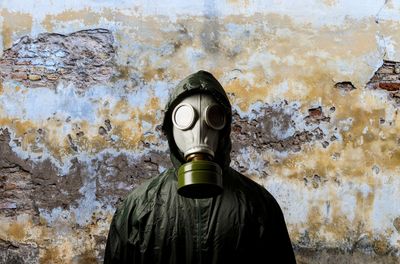


The trains in the Tokyo underground are usually quiet during the early morning rush hour. No one speaks to one another. Like many other busy city commutes, people are still waking up or preparing themselves for the day ahead. It was noteworthy then that, as the young woman settled herself into a seat, she became aware that the people around her were coughing.
Let us know what you think about your experience with The Vault: click here.
“Uh oh”, she thought, “everyone’s coming down with colds”.
As the train pulled up to the next stop, an unusually large number of passengers departed the vehicle. This was another oddity as that stop was usually quiet, but the woman didn’t pay much attention as she carried on her journey. However, things quickly took a turn from there.
As the coughing continued around her, the woman became aware of a weird light on the train.
“[T]he carriage interior looked awfully bright,” she explained, “or what I took at the time to be brightness, though thinking back on it later, it was yellow, or rather a light pearl tinged with yellow. I’ve fainted from anemia before, and it was like that.”
She then started to feel like she was suffocating. She attempted to open the windows, but that didn’t help, and there was a smell. “It wasn’t a pungent smell,” she recalled. “How can I explain? It was more of a sensation, not a smell, a ‘sufficatingness’.”
Her symptoms continued to worsen, along with those of everyone else around her. And yet no one made a noise or showed signs of panic. After watching an officer with white gloves enter another carriage and leave with an object covered in a newspaper, the woman’s condition became intolerable
“I felt absolutely awful. My eyes were twitching, like muscular convulsions, though they didn’t hurt, but everything was yellow.”
When she finally left the train, the woman had one thought go through her mind: “This has to be sarin.” She was right.
The story I just recounted was recorded by the Japanese author Haruki Murakami following the sarin gas attack on the Tokyo Underground in March 1995, which killed 13 people and seriously injured thousands more. The woman in question, who asked to remain anonymous for fear of retribution from the group responsible for the attack, provides a rare first-person account of what it’s like to come into contact with this deadly substance. What’s notable is that, despite only minimal exposure, her body underwent a horrific experience.
Over the last few decades, we have seen several high-profile incidents where chemical weapons have been used against civilians by either state or non-state actors, even though these weapons are meant to be banned by international law. For instance, in 2013, the world was shocked by reports of sarin gas, along with chlorine gas, being used against civilians by the Assad regime during the Syrian war.
Then, in 2018, Russia is suspected of using Novichok, a novel nerve agent, against defectors in the UK in what is now known as the Salisbury Poisoning.
To be sure, chemical weapons are not new inventions. Humans have been utilizing various poisonous or toxic substances for hunting or warfare for millennia. However, modern chemical weapons are significantly deadlier than historical versions, not just in their potency, but also their delivery systems. In fact, modern chemical weapons, like sarin, are designed to interfere with specific aspects of human biology. But sarin is not the only weapon out there – there are multiple types of chemical weapon, each targeting different parts of our bodies.
Nerve agents
When people think about chemical weapons today, it is likely that sarin is the specific substance that first jumps to mind. Created in the mid-20th century, sarin is classified as a G-series (German series) as it was first synthesized in Germany during the 1930s as an enhanced insecticide. However, its lethal potential was soon recognized and then weaponized by the Nazis.
G-series weapons – sarin, tabun, and soman – were specifically designed to target the nervous system, which gave them the name “nerve agents”. In the decades that followed the Second World War, more nerve agents were created, including VX (classed as a V-series agent developed by the British during the Cold War), and Novichok (an A-series agent probably developed by Russia in the late Cold War period).
Exposure to nerve agents can easily be fatal with minutes or hours. They can appear in vapor or liquid forms where they are inhaled or absorbed into the skin, eyes, or other mucus membranes through contact.
They get their name from the fact they interrupt the ways nerve signals work. Under normal conditions, the brain communicates with the rest of the body by sending electrical impulses through nerve cells to organs, muscles, and glands. When an impulse is detected at a nerve ending, the cell releases neurotransmitter molecules that diffuse across synapses – microscopic gaps between nerve cells – and then bind to receptor sites on nearby postsynaptic cells. These cells receive the signal and initiate physiological responses.
One important neurotransmitter in the brain and peripheral nervous system – the nervous system outside the brain and spinal cord – is acetylcholine. Normally, this neurotransmitter is broken down by an enzyme called cholinesterase after it has been released into the synapse, resetting it so new signals can be received.
However, nerve agents like sarin – also known as organophosphorus nerve agents – block cholinesterase from doing its job. The result is an excessive buildup of acetylcholine in the synapse that eventually leads the postsynaptic neuron to seize up from continued arousal.
How does this manifest? Well, like the unknown woman on the Tokyo Underground in 1995, a person exposed to a nerve agent will experience breathing difficulties as their chest muscles stop functioning properly. For someone more directly exposed to the agent, however, these breathing difficulties will be far more severe. They will experience major convulsions and die from asphyxia within minutes.
Choking agents
Anyone who’s studied the First World War will be familiar with the horrors of gas on the front lines. In many ways, this war can be referred to as the chemist’s war because of the large-scale mobilization of scientific and industrial efforts by the warring nations. In particular, the development, production, and deployment of war gases introduced a new and terrifying dimension to combat. The first of this insidious type of weapon was chlorine gas, which was released by the German army on April 22, 1915.
The gas was arranged in over 6,000 steel cylinders lined up along the German perimeter of Ypres, Belgium. When the order to release the gas was given, it spilled from the cylinders and practically rolled as a wall towards the opposing French trenches, causing terror and a panicked retreat.
“Just at dawn they opened a very heavy fire, especially machine-gun fire, and the idea of that was apparently to make you get down. And then the next thing we heard was this sizzling – you know, I mean you could hear this damn stuff coming on – and then saw this awful cloud coming over,” Martin Greener, a British officer, recalled in an aural history decades after the events.
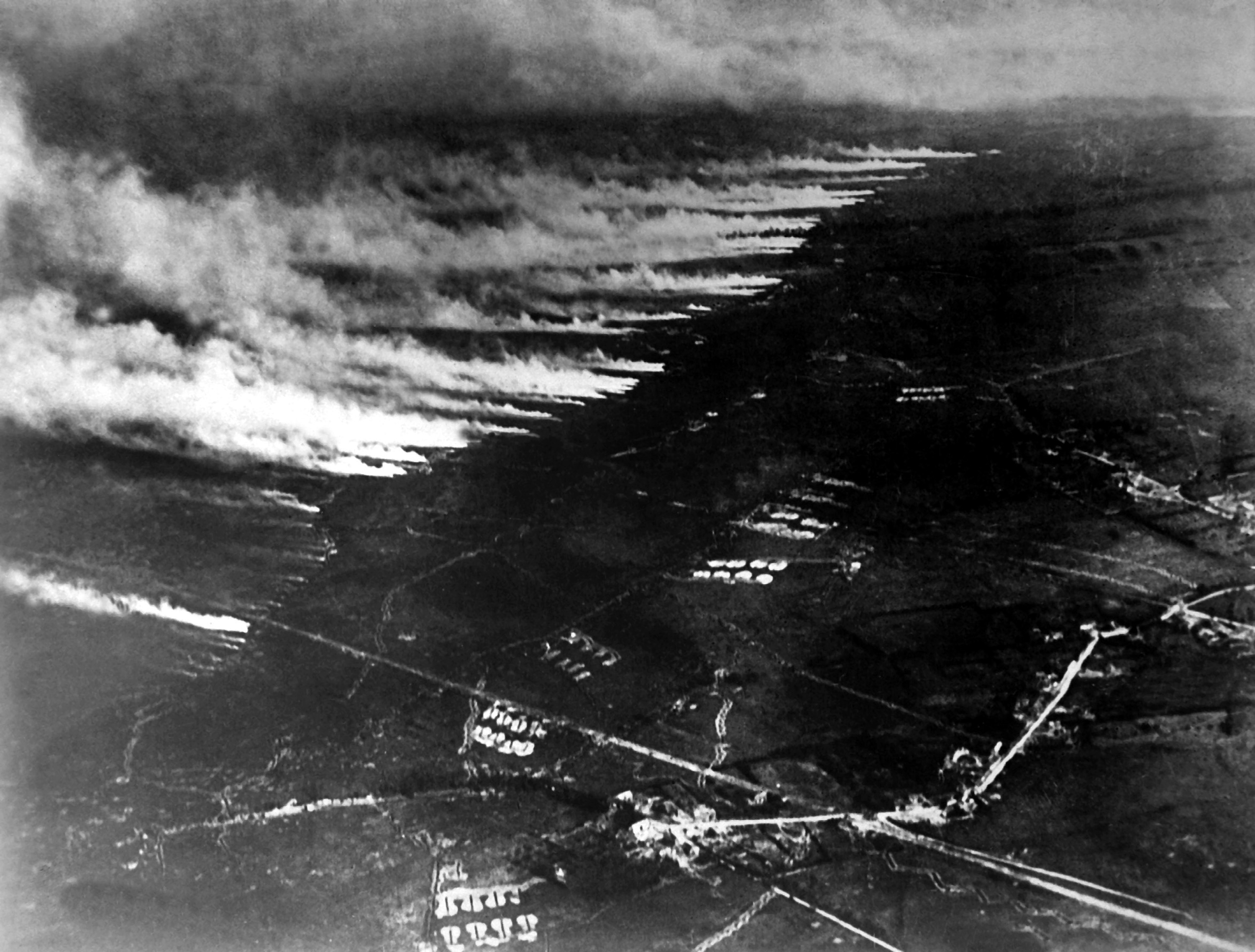
“A great yellow, greenish-yellow, cloud. It wasn’t very high; about I would say it wasn’t more than 20 feet up. Nobody knew what to think. But immediately it got there we knew what to think, I mean we knew what it was. Well then of course you immediately began to choke, then word came: whatever you do don’t go down. You see if you got to the bottom of the trench you got the full blast of it because it was heavy stuff, it went down.”
As far as modern chemical weapons go, chlorine gas is comparatively crude. It is a member of what are called choking agents, which were designed to suffocate their targets. Choking agents – chlorine gas, diphosgene, chloropicrin, and phosgene (these last two were developed and used by the British in the First World War) – cause severe swelling and irritation to the respiratory tract (nose, throat, and lungs).
_-_Gassed_-_Google_Art_Project.jpg "A painting showing injured First World War soldiers. The main focus is a line of 10 men being led by another solider. The ten men have bandages over their eyes and have one hand on the shoulder of the person in front of them. One the floor surrounding these standing men are many more with bandages on their eyes. They're all laying around as they recover.")
Choking agents can appear in liquid, gaseous, or aerosolized forms. While chlorine forms a dense, yellow-colored cloud with a striking smell, phosgene and chloropicrin are colorless, though they both still have strong odors (the former has been described as smelling like freshly mown hay while the latter has a sharper scent that has been compared flypaper).
When they enter the airways, these agents react with the thin, moist membranes in the nose, throat, and lungs that allow us to take in oxygen. Chlorine, which is highly reactive and soluble in water, undergoes a disproportionation reaction with water molecules in the mucus to produce hydrochloric acid, which breaks down the proteins in the cell membranes. This can lead to apoptosis (cell death) and extreme inflammation.
At the same time, hypochlorous acid is produced, which is a powerful oxidizing agent that penetrates into the cell walls and disrupts the cell’s internal chemistry.
However, chlorine reacts extremely quickly in the upper airways, so it produces coughing in its targets. This can serve as a warning system that gives people a chance to flee the areas.
In contrast, phosgene is far more insidious. It is less soluble in water, so passes through the upper airway without a reaction. It then settles in the alveoli – the broccoli-like air sacs in our lungs that allow for oxygen transfer – where it eventually breaks down into acid. Because this process is far slower than it is with chlorine, the hydrochloric acid it produces is able to break down the lung tissue before symptoms manifest in its victims.
Phosgene also bonds with specific chemical groups found in lung proteins and lipids (amino, hydroxyl, and thiol groups). Essentially the agent’s molecules glue proteins together or alter their shape so they can’t function. This leads the lungs to become “leaky”, slowly filling up with fluid that prevents the lungs from deflating to when you breathe out. The ultimate outcome is that someone exposed to sufficient quantities of this gas will essentially drown in their own lungs.
Blister agents
The horror of trench warfare was not just limited to choking agents. As the war moved on, researchers sought alternative chemicals for killing their opponents. One such creation is sulfur mustard (dichlorethyl sulfide), which was originally developed in the 19th century before being recognized for its killer potential by German scientists like Fritz Haber.
The chemical gets its name from the yellow-brown colored clouds it forms when used in warfare, well as the characteristic odor that marks it out. In addition to sulfur mustard, there is also nitrogen mustard and lewisite (developed in the early 20th century and not weaponized in the First World War, though a number of nations stockpiled it afterwards), and phosgene oxime.
These chemicals are known as blister agents (vesicants) and are the most common chemical weapons agents. They are typically oily substances that enter the body through inhalation or direct contact with the skin or eyes. Exposure to this type of agent will usually result in large blisters that are excruciatingly painful and often disfiguring too. Contact with the eyes can lead to corneal damage, blindness and conjunctivitis, while inhalation can be followed by respiratory complications, such as inflammation, coughing, bronchitis, pneumonia and even respiratory failure.
.jpg "An image showing a cross section of lung being damaged by mustard gas. The image is of a circle with a webbing of red lines making up the ling tissues. At the center is a large grey blob that extends through the tissue to the lower right hand corner.")
A chemical like sulfur mustard is lipophilic, which means they dissolve easily in fats, oils, and lipids. This is why they cause the most injury to areas of the skin with lots of sweat (eccrine) and sebaceous glands (with the face, groin, and armpits being particularly vulnerable areas). Once absorbed, they can penetrate deeper into the surrounding tissues – this is why sulfur mustard and other blister agents can cause severe injury without immediate pain or showing signs of damage.
Blister agents all damage the skin and sensitive tissues by breaking down the structures that hold cells together. This interferes with their ability to repair or divide and can result in apoptosis. As a result, large, fluid filled blisters form (along with severe burns). This fluid can also be dangerous, so the injury can be spread if care is not taken (even to caregivers and medical staff).
Although exposure to these types of weapons often leads to high numbers of casualties, deaths are usually lower.
Ever since the Chemical Weapons Convention entered into force in 1997, the development, production, and stockpiling of this class of weapon and its precursors – the chemicals used to make them – has become illegal across the world. This global consensus has reduced the threat of such weapons being used in future conflicts.
However, as the events of the last decade or so have demonstrated, the continued existence of such an international norm cannot be taken for granted. Time will tell whether this significant achievement of the 20th century can survive the 21st.
We want to know your thoughts on your experience so far with The Vault. Click here to have your say.