Space and Physics
 PUBLISHED


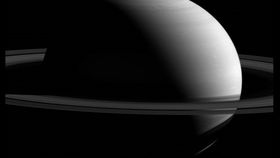


This latest picture of Saturn highlights just how big the lord of the rings actually is. The photograph was taken last March from 2.6 million kilometers (1.6 million miles) away and shows Saturn in near-infrared light.
The planet has a diameter of over 116,000 kilometers (72,000 miles), almost ten times Earth's, and the main ring system itself is six Earths wide. Saturn’s size is even more striking when compared with its menagerie of moons. Saturn has 62 natural satellites, but only 13 of them have a diameter larger than 50 kilometers (31 miles). One of those satellites, Tethys, can be seen in the lower right corner of the picture.
Tethys is about 1,060 kilometers (660 miles) across and although it’s the second brightest moon of Saturn (after Enceladus), it was artificially brightened for this picture.
The Cassini mission is a joint mission of NASA, ESA, and the Italian Space Agency. It has been studying Saturn and its moons since 2004 and it will complete its mission in September 2017, when it will enter Saturn’s atmosphere and be destroyed.