Space and Physics
 PUBLISHED
 3
3




For all our fancy telescopes and particle accelerators, we still haven’t managed to detect even a smidgen of dark matter. In a dramatic change of course, researchers at Virginia Tech are now taking a staggeringly low-tech approach to the hunt by looking for the elusive stuff in a bunch of old rocks.
While most scientists are pretty convinced that dark matter is indeed a thing, to date we’ve only ever been able to detect it indirectly. For instance, we know that all of the observable mass doesn’t account for the strength of gravity at certain points in the universe, which can only be explained by the presence of some invisible substance lurking all around us.
For decades, physicists have speculated that it may be possible to witness dark matter in action if we can somehow catch it colliding with an atomic nucleus. In such a scenario, a spark of energy is likely to be produced, thus giving us something tangible to work with.
And that’s where the rocks come in. Given that our planet is billions of years old, there’s a high chance that ancient rocks in Earth’s crust have at some point collided with dark matter. Where this has happened, it should be possible to observe nuclei that have been bumped out of place, thus leaving anomalies and imperfections in a mineral’s crystal structure.
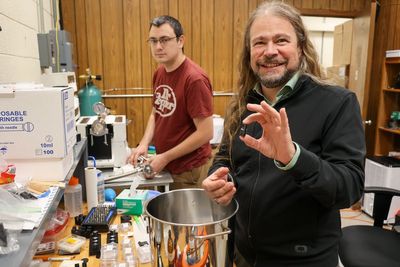
Researchers are therefore building a new lab at Virginia Tech’s Robeson Hall where they will use sophisticated imaging techniques to hunt for these miniature trails of destruction left inside old rocks. Explaining the proposed method in a statement, quantum systems expert Vsevolod Ivanov said “we’ll take a crystal that’s been exposed to different particles for millions of years and subtract the distributions that correspond to things we do know.”
“Whatever is left must be something new, and that could be the dark matter.”
Of course, learning to identify the traces and patterns left behind by other sources of radiation is going to be a major challenge. At present, the team are conducting a series of tests using synthetic lithium fluoride in order to image the particle tracks attributable to cosmic rays, which must be subtracted in order to isolate the echoes of dark matter collisions.
Explaining his motivation for taking on this monumental challenge, project leader Patrick Huber said “it’s crazy. When I first heard about this idea, I was like - this is insane. I want to do it,”
“Other people in their midlife crisis might take a mistress or get a sports car. I got a lab.”