Space and Physics
 PUBLISHED




What you'll discover in this article
- Mercury-bound mission BepiColombo is about to drop its propulsion module, a crucial milestone ahead of its arrival at the planet.
- The process will be livestreamed tomorrow.
- “For the first time, we'll have a single mission with two orbiters going around the same planet,” a mission lead, Professor Geraint Jones, told IFLScience
The wait is almost over. BepiColombo is almost at Mercury, and the excitement is palpable. Especially since a major milestone is happening tomorrow, September 3, when the mission will drop a massive chunk of its spacecraft.
BepiColombo is a mission like no other. The European Space Agency (ESA) and the Japan Aerospace Exploration Agency (JAXA) worked together to send not one but two spacecraft together to the planet Mercury. And it took a very long time.
A groundbreaking mission
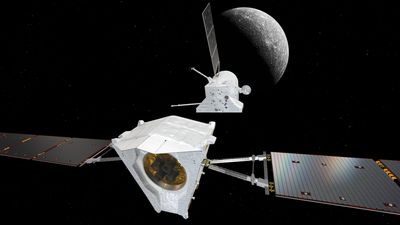
BepiColombo is a three-in-one spacecraft. It is made of the Mercury Transfer Module (MTM) which provides the power and solar electric propulsion, and two orbiters: the Mercury Planetary Orbiter (MPO), built and operated by ESA, and Mio (the Mercury Magnetospheric Orbiter, MMO), built and operated by JAXA.
BepiColombo really represents the next level of capability at Mercury and will be able to make significant new discoveries about the planet and its space environment over the next few years.
Professor Emma Bunce
Tomorrow, BepiColombo will drop MTM in preparation for the two orbiters getting around Mercury. This is a crucial milestone in terms of operation. MTM got the spacecraft safe and sound almost to Mercury, but its time is now up.
Still, this is both an ending and a beginning as the science mission is almost upon us.
“For the first time, we'll have a single mission with two orbiters going around the same planet,” Professor Geraint Jones, Lead Project Scientist of BepiColombo, told IFLScience.
MPO will study the surface, interior, and extremely tenuous atmosphere of the planet, while Mio will focus on the magnetic environment of Mercury and the solar wind, the stream of charged particles coming from the Sun.
The two orbiters will also take complementary measurements from different places around the planet, providing important insights into Mercury. The planet has plenty of mysteries that need solving.
“Previous Mercury missions have included flybys (Mariner-10) or a one spacecraft effort (MESSENGER) and while they have made fantastic discoveries, BepiColombo really represents the next level of capability at Mercury and will be able to make significant new discoveries about the planet and its space environment over the next few years – there is still a great deal to learn,” Professor Emma Bunce, from the University of Leicester and Principal Investigator of the Mercury Imaging X-Ray Spectrometer on Bepi, told IFLScience.
Using the Sun like a flash
The MIXS instrument is a fantastic tool to study the planet. X-ray light from the Sun hits the surface of Mercury and makes the rocks glow. By studying that very glow with MIXS, the team will study the composition of the surface and learn so much more about the closest world to the Sun.
“At the end of the mission we hope to have a new global map of the surface of Mercury at X-ray wavelengths, plus high spatially resolved images of particular features of interest. All of this will help us to understand the origin and evolution of the planet and the surface, including volcanic features, impact craters, and hopefully intriguing features such as hollows,” Bunce told IFLScience.
Mercury is massively affected by the Sun. Previous work by BepiColombo during its many flybys has even revealed that its rocks glow due to plasma raining down on the planet, in a phenomenon akin to aurorae.
“Personally I am also very interested in the bonus science we can do with MIXS on the nightside of the planet, where there is no solar photon interaction, but where we know from MESSENGER that there is an X-ray emission present likely produced by electron precipitation from the space environment,” Bunce continued.
“On a planet where there was an atmosphere, this might look like the aurora, but on Mercury the particles are interacting directly with the surface, causing it to light up at X-ray wavelengths. Studying this will tell us about magnetosphere processes and this rather unusual situation in the solar system where the space environment is interacting directly with the surface.”
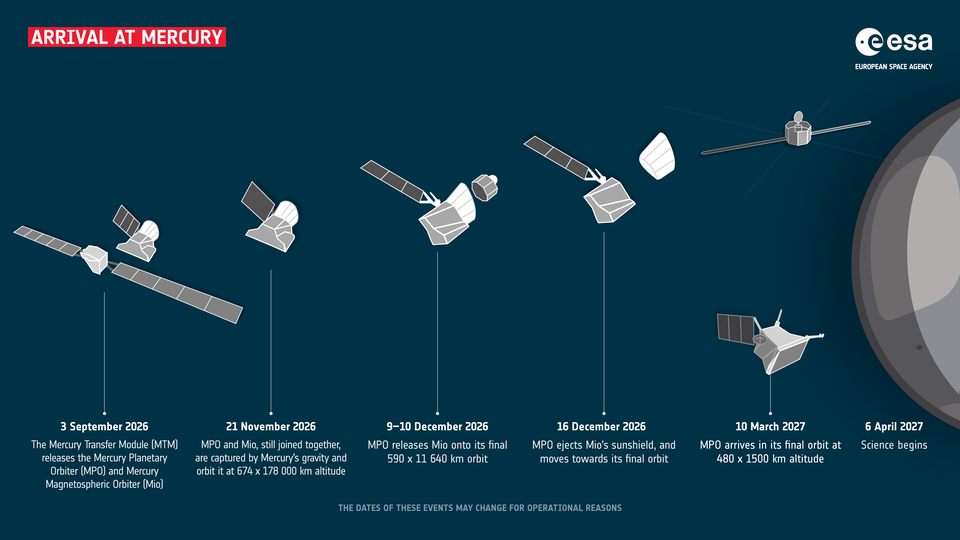
MPO and Mio will enter orbit on November 21, and at that point, they will still be bound together. A few weeks later, MPO will release Mio into its final orbit. It will take a little bit more maneuvering for MPO to settle into its configuration. That will happen on March 10, 2027. Then April 6 is when all the science kicks off.
It’s been a long road
BepiColombo has been traveling for over 8 years and has had to deal with some serious issues that required one of the most daring space maneuvers ever attempted by an uncrewed spacecraft. That aside, getting to Mercury is never a walk in the park.
“Traveling to Mercury is really, really challenging; that's why so few missions have gone there. To go and take two orbiters, to go into orbit around the planet, takes a lot of energy,” Jones told IFLScience.
You might think getting to the Sun would be easy; don’t we wish constantly to shoot our enemies there? Unfortunately, it is not. Anything launching from Earth comes with our planet’s orbital velocity. So, to get to the inner Solar System, you have to lose that kinetic energy.
Italian mathematician and engineer Giuseppe "Bepi" Colombo was the first to work out how to get a spacecraft into a solar orbit so that it would encounter Mercury multiple times. Mariner 10 was the first spacecraft to perform multiple gravity assists. BepiColombo is named after him.
BepiColombo has performed nine planetary flybys, one by Earth, two by Venus, and a whopping six by Mercury. And the target is now just months away.
ESA will have a livestream from the European Space Operations Centre as the spacecraft separates. It will take about two hours between separation and confirmation. Unfortunately, no live pictures of the process will be available.
A long-term investment that spans borders
When asked about what she’d like the general public to know about BepiColombo, Bunce stressed that none of the process behind developing a spacecraft is done overnight:
Working together, we can achieve so much more than if we were doing this separately.
Professor Geraint Jones
“I would love people to understand how long it takes to build an instrument for a space mission (15 years!), how challenging it is to prepare that instrument to travel to the inner Solar System and operate in an extremely challenging thermal environment, how patient we have to be to then wait 8 years before we can operate our instrument, and how many wonderful people have contributed to this major achievement!”
She also stressed the international collaboration aspect, a sentiment echoed by Jones.
“It's fantastic working together with our Japanese colleagues on this scientific effort,” he told IFLScience. “Hundreds of scientists from Europe, Japan, and beyond are working very closely together to investigate this neighbor of a planet that's common to all of us.”
“Working together, we can achieve so much more than if we were doing this separately.”
And that's a sentiment that can be applied well beyond planetary science.
The MTM separation is expected to happen at 2pm CEST (8am ET) on September 3, and the confirmation that it all happened successfully should arrive, at the earliest, about 1 hour 53 minutes later.