Space and Physics
 PUBLISHED



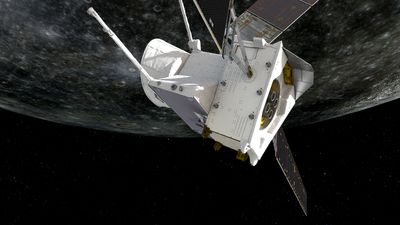


On June 23, BepiColombo will pass just 200 kilometers (124 miles) above the surface of Mercury, using the planet’s gravity to slow down and get closer to its long-term plan: actually getting into orbit around Mercury.
The European Space Agency (ESA) and the Japanese Space Agency (JAXA) had this flyby planned years in advance. The only way to reach the inner portion of the solar system is by slowing down your spacecraft massively as it carries the velocity of the Earth with it. One way to do so is by spending a lot of fuel – alternatively, you can use planets to put you on the right orbit.
BepiColombo is named after Giuseppe “Bepi” Colombo, the Italian mathematician that worked out the way to fly by Mercury using a gravitational assist from Venus. To get into orbit around the planet, more flybys are needed. The craft has already performed one of Earth, two of Venus, and one of Mercury.
The upcoming second one will have BepiColombo flying over the planet with a relative speed of 7.5 kilometers (4.66 miles) per second. By moving the spacecraft around the planet, its velocity with respect to the Sun will slow by 1.3 kilometers (0.8 miles) per second. Closer to the speed of Mercury, but not quite yet. Four more flybys will be needed.

While the spacecraft is still mostly in navigation mode, rather than science mode, it will use the brief encounter with Mercury to take some images and collect some data. The images should be released on June 27.
“Even during fleeting flybys these science ‘grabs’ are extremely valuable,” Johannes Benkhoff, ESA’s BepiColombo project scientist, said in a statement. “We get to fly our world-class science laboratory through diverse and unexplored parts of Mercury’s environment that we won’t have access to once in orbit, while also getting a head start on preparations to make sure we will transition into the main science mission as quickly and smoothly as possible.”
The third flyby of Mercury will be on June 23, 2023. BepiColombo will finally get into orbit around the planet on December 5, 2025.