Space and Physics
 PUBLISHED


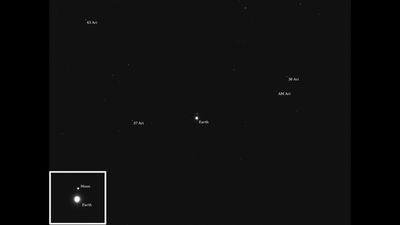


The Psyche spacecraft has been steadily making its way to its asteroid target, a fascinating metal-rich asteroid also named Psyche. This world is believed to be what remains of the metallic core of an almost-planet, but the story might be a lot more complex, as recent research suggests. The mission still has a long way to go before reaching the asteroid, but it's testing its instruments, and that means taking pictures, including of us.
Its latest image of Earth and the Moon came from multiple long exposure images (up to 10 seconds) taken by Psyche on July 20 and 23. The mission used its twin cameras to do that, which were used earlier this year to snap an image of Jupiter and Mars appearing together in the sky (below). The team wanted to make sure there were no changes in the image performance. There will be more pictures and more tests.
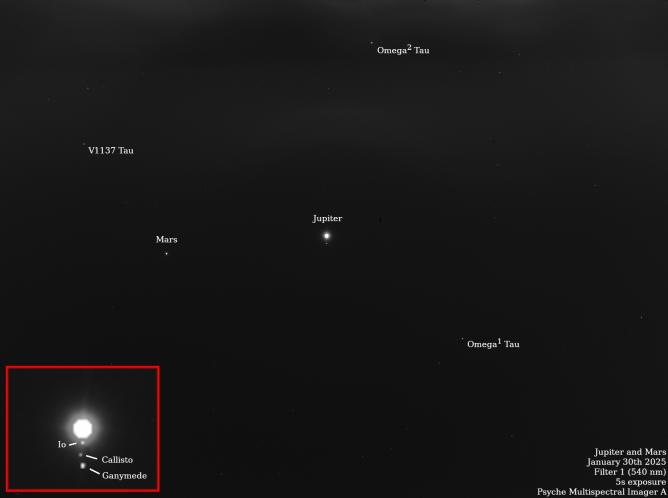
“After this, we may look at Saturn or Vesta to help us continue to test the imagers,” Jim Bell, the Psyche imager instrument lead at Arizona State University in Tempe, said in a statement. “We’re sort of collecting Solar System ‘trading cards’ from these different bodies and running them through our calibration pipeline to make sure we’re getting the right answers.”
The spacecraft was 290 million kilometers (180 million miles) from our planet when the image was snapped. The Earth and Moon are seen among the stars of the Aries constellation. The cameras continue to function as expected, so all is well.
Psyche will reach its namesake asteroid in July 2029. The spacecraft will encounter Mars next May for a gravitational boost, which will send it on the right trajectory with little fuel expenditure.
The mission has also tested its optical communications system, sending messages, including a cat video, from hundreds of millions of kilometers away using lasers, something that might one day be used to bring high-speed internet to Mars.


 1
1