Space and Physics
 PUBLISHED


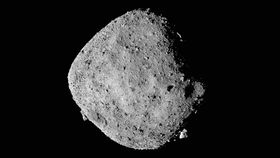


Using NASA’s OSIRIS-REx, researchers have found the first evidence of thermal stress weathering on an airless body. The team are currently studying asteroid Bennu in detail in preparation for its descent toward the surface later this year. In doing so, they found that rocks on the asteroid crack due to the difference in temperature from night to day.
As reported in Nature Communications, the spacecraft is orbiting 600 meters (0.4 miles) from the surface of the asteroid, which is the closest-ever orbit around a celestial object. This has allowed for high-resolution observations of boulders on the surface.
“This is the first time evidence for thermal fracturing has been definitively observed on an object without an atmosphere,” lead author Jamie Molaro, from the Planetary Science Institute, said in a statement. “It is one piece of a puzzle that tells us what the surface used to be like, and what it will be like millions of years from now.”
The temperature difference on Bennu is quite striking. During the day, temperatures can measure a scorching 127°C (260°F) and at night a frigid -73°C (-100°F). This change is pretty rapid as the asteroid spins on its axis every 4 hours and 18 minutes. Despite the constant and significant thermal excursion, the team were uncertain whether or not they would observe thermal stress weathering.
“On Earth, there are chemical weathering processes that help make thermal fracturing more efficient," Molaro explained. "The presence of air and moisture within cracks makes them easier to grow, and so on Earth this effect really cannot be decoupled from the effect of the thermal stresses themselves. We’ve observed evidence of thermal fracturing on Earth and on Mars, both environments where chemical weathering may play a role. Therefore, while it was theoretically possible for thermal fracturing on an airless body to occur alone, it was not clear whether or not the stresses would be strong enough to cause crack growth in absence of the chemical effects."
OSIRIS-REx has shown that Bennu is, essentially, a large clump of rubble loosely held together by gravity. The spacecraft will fly down to the surface in October to collect a sample before bringing it back to Earth in a few years.

Exfoliation features on a cliff face (a) and on boulders (b-f) with varying size and location. The bright dome on the horizon of panel (a) is a boulder behind the exfoliating cliff. NASA/Goddard/University of Arizona

 1
1