Humans
 PUBLISHED


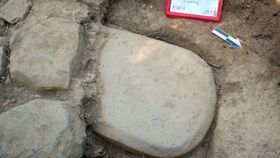


Archaeologists in Tuscany, northern Italy, have uncovered a rare example of what they believe to be an Etruscan sacred text dating back to the 6th century BCE. Found embedded in the foundations of an ancient temple, the inscription is expected to reveal details of the Etruscan pantheon of gods, enabling researchers to fill in the gaps in their knowledge about this long-lost culture, while also refining their mastery of the Etruscan language.
Exerting a strong influence over much of northern Italy between 800 and 400 BCE, the Etruscan civilization is credited with laying the foundations of some of the country’s most culturally significant cities, including Florence, Pisa, and even Rome.
Until now, the biggest clues about Etruscan life have come from brief inscriptions found on graves and other funerary items. Studying these findings has enabled researchers to learn the basics of the Etruscan language, although long texts describing the finer points of this ancient culture have remained conspicuously absent from the body of archaeological evidence.
It’s for this reason that scholars are so excited about the new discovery, which consists of a large stone slab measuring almost 1.2 meters (4 feet) in height and over 0.6 meters (2 feet) in width. Known as a stele, the enormous 225-kilogram (500-pound) block appears to contain a lengthy inscription, although thousands of years of weathering and erosion have left only 70 letters and punctuation marks visible to the naked eye.
Discovered by researchers from the Mugello Valley Archaeological Project at the Poggio Colla site, the stele is due to undergo extensive conservation at the Tuscan Archaeological Superintendency in Florence, where experts will use photogrammetry and laser scanning to reveal the remaining characters.
Principle Investigator Gregory Warden commented on the finding by saying “we hope to make inroads into the Etruscan language.” While previous discoveries have already shed light on the fundamentals of Etruscan grammar, “long inscriptions are rare, especially one this long, so there will be new words that we have never seen before.”
In addition to providing new insights into the workings of this ancient language, Warden is also particularly hopeful that the stele “will reveal the name of the god or goddess that [was] worshipped at this site.” In doing so, it may help to shed light on the belief system at the heart of one of western civilization’s most fundamental ancestral cultures.


 1
1