Space and Physics
 PUBLISHED





Change is a crucial facet of the universe, but when it comes to planets, change is often measured in eons rather than years. Especially on planets that aren’t very active, like Mars. And yet, in just 50 years, we've noticed some pretty big changes happening on Utopia Planitia, which was possibly once part of a large northern ocean on the Red Planet and is now a vast plain. Shadowy volcanic ash is spreading, even though volcanos on Mars have been dead for tens of thousands of years.
The European Space Agency has released a beautiful new picture of part of this region. Captured by Mars Express's high-resolution stereo camera, it shows two contrasting halves. On one side, the bright red-orange of the classic Martian terrain. On the other, the dark volcanic ash from ancient eruptions.
The image is visually stunning and tells us a lot already about this wonderful planet. But there is an even more important reason why it is exciting. Photographs from NASA’s Viking mission of the same region in 1976 show the ash covering far less of the surface.
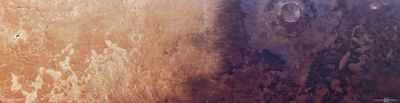
.gif "An overhead map view of the Martian surface in brown and orange tones. The upper area is darker and mottled, while the lower area is lighter and smoother. A thin white rectangle highlights a vertical section near the centre.")
Over the past 50 years, the volcanic ash has spread over tens of kilometers. Or has it? It is unclear what mechanism is causing this change to happen. It clearly isn’t a new deposit of ash, but the volcanic material – made mostly of what’s called mafic material, such as olivine and pyroxine – is becoming more spread out. The key player here must be Martian wind, but it could be doing two different things.
The wind might be picking up the ash deposits, likely from the Elysium Mons region that isn’t too far from the site. The wind then slowly but surely covers the red sand in the darker ash. Alternatively, the ash was there before the sand, older and buried, and only now is the wind clearing it off and revealing what lies beneath.
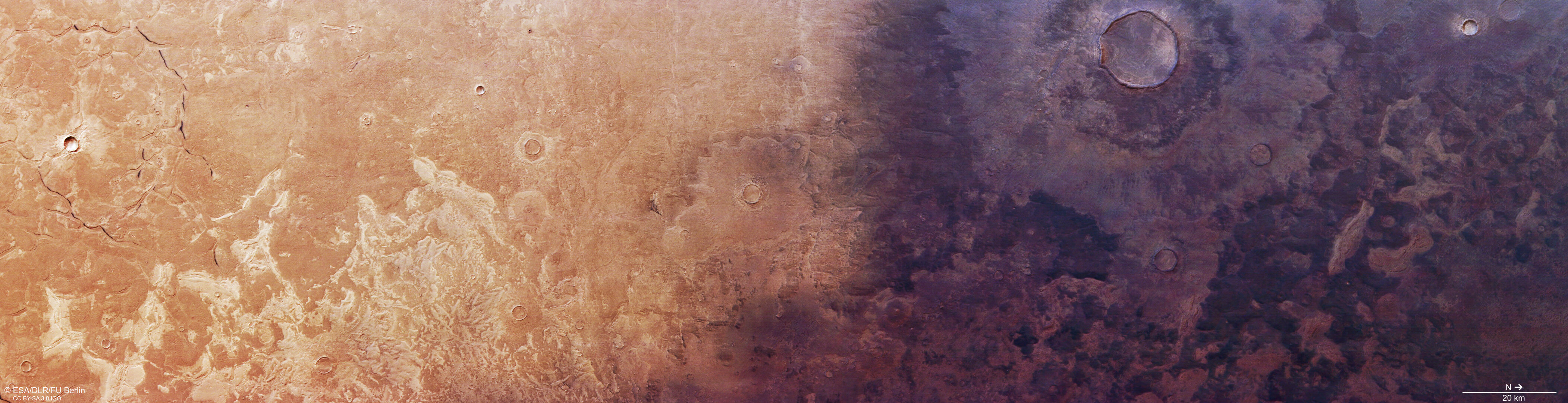
The color is the most obvious but not the only evidence of changes in Utopia Planitia. Researchers believe the region has buried deposits of ice, and some of them are, due to melting and escaping gas, creating pits with wavy edges called “scalloped depressions,” which can be seen in the ash-covered region.
The lighter-colored region also has interesting geology. Fractures extending for 20 kilometers (12 miles) and as wide as 2 kilometers (1.2 miles), called graben, can be seen. Mars might not experience the impact that our atmosphere and plate tectonics have on our planet, but its surface isn’t at all static.