Humans
 PUBLISHED
 6
6




While casually reading news about a slate tablet unearthed in Spain, a sharp-eyed researcher noticed the archaeologists had missed a huge discovery: not only did it feature the engravings of battling warriors, but also the mysterious alphabet of an ancient language.
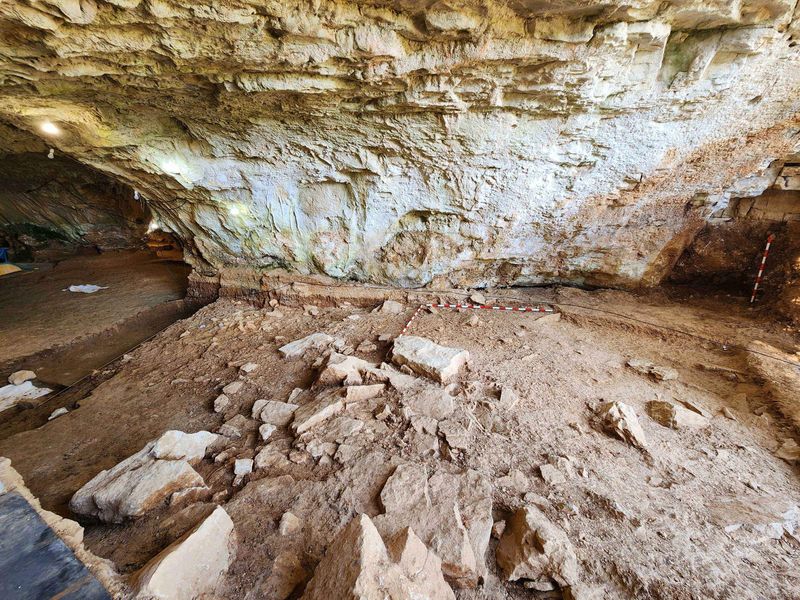
The 20-centimeter (7.8-inch) tablet was recently unearthed during an archaeological dig near the Spanish town of Guareña. Known as Casas del Turuñuelo, the site belongs to the late Tartessian civilization that developed in the southwestern Iberian Peninsula around 2,500 years ago.
When the Spanish National Research Council revealed the discovery on June 6, they simply explained that it depicted battling individuals who were identified as warriors.
The news caught the attention of Joan Ferrer i Jané, a computer scientist and expert in Paleohispanic languages at the University of Barcelona, who quickly realized the artifact was even more significant than the initial reports had suggested.
“Beyond the figures, when I looked at the plaque I saw that on one of the sides, there seemed to be a Paleo-Hispanic sign; a sign that cannot be confused with any other,” he said in a statement.
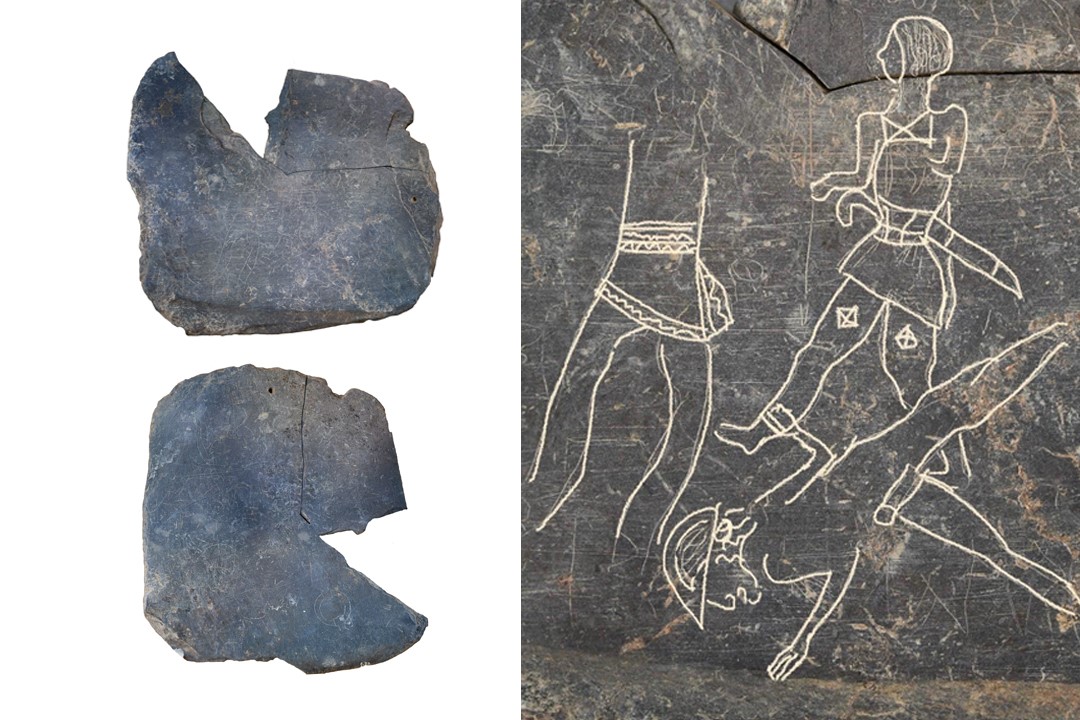
He contacted the Institute of Archeology of Mérida for better images of the slab to discover it contained a beautiful (and very rare) example of southern Paleohispanic writing.
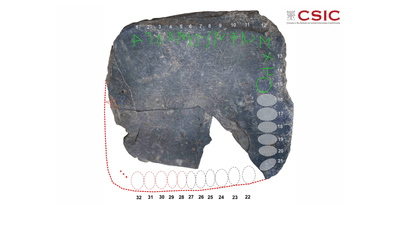
“After studying the images, everything indicates that it is a southern script alphabet with the initial sequence ABeKaTuIKeLBaNS?ŚTaUE, which is almost the same as documented in the Spanish alphabet, except for the 11th sign, which has a special shape," explained Ferrer.
Paleohispanic scripts – the writing systems used in the Iberian Peninsula before the Latin alphabet arrived – are divided into at least two families: the northeastern family and the southern family. It is believed all of these scripts stem from the Phoenician writing system, developed by the Phoenicia civilization that thrived around 3,000 years ago along the coast of the eastern Mediterranean in modern-day Lebanon, Syria, and Israel.
The new discovery is particularly remarkable as there are only two other pieces of evidence that show alphabets of southern Paleohispanic writings. As such, we know very little about this writing system.
There may even be letters or symbols that are yet to be discovered; the bottom part of the tablet is broken off, but Ferrer said that the slate might have once depicted as many as 32 symbols.
“This alphabet has 27 signs and is the only complete one we know to date. Another was found in the excavation of Villasviejas del Tamuja (Cáceres), but it is very fragmented. It only has some central signs. Therefore, [the new alphabet] would be the third example and provides a lot of information,” explained Ferrer.