Space and Physics
 PUBLISHED
 2
2



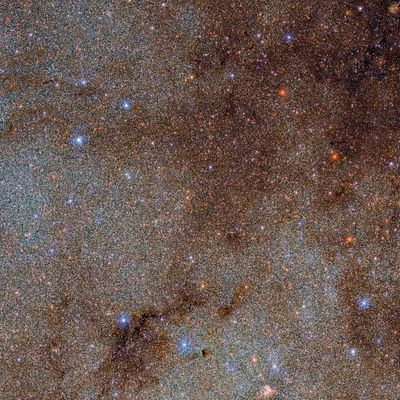


After more than five years, the second data release from the Dark Energy Camera Plane Survey (DECaPS2) has been published and it was certainly worth the wait. Astronomers have imaged a staggering 3.32 billion objects in this new survey of the galactic plane of the Milky Way.
This incredible astronomical feat is publicly accessible and took 21,400 exposures combined into 10 terabytes of data. The images cover about 6.5 percent of the night sky, stretching across the 130 degrees in length that the plane of the Milky Way inhabits. If you take the full Moon as your unit of area of the sky, you’d need 13,000 full Moons to cover it completely: a vast area full of intriguing astronomical sources.

“One of the main reasons for the success of DECaPS2 is that we simply pointed at a region with an extraordinarily high density of stars and were careful about identifying sources that appear nearly on top of each other,” said lead author Andrew Saydjari, from the Center for Astrophysics, Harvard & Smithsonian, in a statement.
“Doing so allowed us to produce the largest such catalog ever from a single camera, in terms of the number of objects observed.”
Identifying the celestial objects in those tens of thousands of observations is no easy task. The plane of the Milky Way has interstellar dust and gas that blocks starlight as well as the brightness of diffuse nebulae, which can mess with the measurements of the individual brightness of stars. The whole region is so crowded that some stars look like they are right on top of each other too. Thanks to a new data-process approach, the team was able to get this survey where all these 3.32 billion objects are recognizable.

“Since my work on the Sloan Digital Sky Survey two decades ago, I have been looking for a way to make better measurements on top of complex backgrounds," said Douglas Finkbeiner, a professor at the Center for Astrophysics, co-author of the paper, and principal investigator behind the project. “This work has achieved that and more!"
The Dark Energy Camera conducted the Dark Energy Survey between 2013 and 2019. It is installed on the Víctor M. Blanco 4-meter Telescope at Cerro Tololo Inter-American Observatory (CTIO) and clearly, it continues to deliver incredible observations. Together with other surveys, this work is pushing beyond the current understanding of our galaxy.
“When combined with images from Pan-STARRS 1, DECaPS2 completes a 360-degree panoramic view of the Milky Way's disk and additionally reaches much fainter stars,” explained co-author Edward Schlafly, a researcher at the AURA-managed Space Telescope Science Institute. “With this new survey, we can map the three-dimensional structure of the Milky Way's stars and dust in unprecedented detail.”
The data release is presented in a paper in The Astrophysical Journal Supplement.