Space and Physics
 PUBLISHED



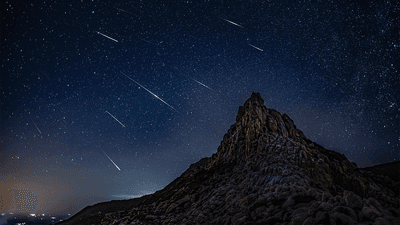


Astronomers using video networks to monitor the skies may have found signs of a new meteor shower caused by an asteroid that was ripped apart by the Sun.
Every year, our planet is treated to several meteor showers as it crosses paths with various clouds of dust and debris. These are generally rubble from comets. The Perseids, for example, are caused by a 26-kilometer- (16-mile-) wide comet that orbits the Sun once every 133 years.
"The pieces of space debris that interact with our atmosphere to create the popular Perseids meteor shower originate from Swift-Tuttle. This annual meteor shower takes place each August and peaks mid-month. It was Giovanni Schiaparelli who realized in 1865 that this comet was the source of the Perseids," NASA explains.
As these tiny fragments hit our atmosphere, sometimes traveling at over 24 kilometers (15 miles) a second, they heat up quickly and begin to burn up, often quite spectacularly.
"When comets come around the Sun, the dust they emit gradually spreads into a dusty trail around their orbits," NASA adds. "Every year the Earth passes through these debris trails, which allows the bits to collide with our atmosphere where they disintegrate to create fiery and colorful streaks in the sky."
But asteroids can be sources of meteor showers, too, with the obvious example being the Geminids, which peak in mid-December every year and are debris from an asteroid known as 3200 Phaethon.
In a new study, Patrick M. Shober at NASA searched through camera observations of the night sky from around the world for the flashes of meteors impacting the atmosphere. Looking through 235,271 meteors and fireballs, Shober found hundreds of meteors that appear to have come from an unknown parent body.
"The 282 meteors associated with this cluster tell the story of an asteroid that got a little too close to the Sun," Shober explains in a piece for The Conversation, adding that meteor showers can be used to find their parent bodies as they travel through the Solar System.
"At first, debris shed by an asteroid or comet travels closely together. Imagine squeezing a single drop of food dye into a moving stream of water: Initially, the dye stays in a tight, concentrated cloud. But as it flows, the water’s swirling currents pull at the dye, causing it to spread out and fade," he explains.
"In space, the gravitational tugs from passing planets act like those currents. They pull on the individual meteor fragments in slightly different ways, causing the once-tight stream to gradually drift apart until it completely dilutes into the background dust of our solar system."
There are only a few known ways for asteroids to produce debris like this, including being broken apart by their own spin or being ripped apart by tidal forces – essentially, the gravity of other objects in the Solar System acting unevenly on the asteroid, causing parts of it to break off.
Modeling the asteroid based on the meteors, Shober suggests they may be the result of a tidal disruption event when an asteroid got a little too Icarus-y to remain one coherent body.
Currently, the parent body of the new meteor shower remains elusive, though Shober notes that this will hopefully change with NASA's upcoming Near-Earth Object Surveyor mission, launching in 2027.
The study is published in The Astrophysical Journal.