Culture and Society
 PUBLISHED
 3
3


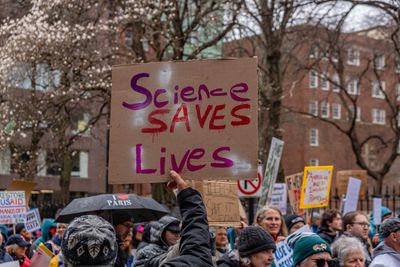


You would be forgiven for thinking that faith in science in the US may be on shaky grounds these days. Ever since the COVID-19 pandemic, there have been increasing concerns about misinformation and conspiracy theories. However, faith in science remains high and has improved since its low points following the pandemic. But a new report suggests some Americans believe the US is now losing ground in scientific research compared to other countries.
It’s been a busy year in the US. Since January 2025, the Trump administration has made some drastic changes to federal science policy. It has reduced the number of existing research grants while also cutting the size of the federal science and health workforce. They have also redirected priorities away from subjects like climate change research while increasing focus on artificial intelligence (AI).
But how has this changing landscape impacted the public perspectives of science as an institution and scientists themselves? Towards the end of 2024, the Pew Research Center, a nonpartisan and nonadvocacy “fact tank”, published a report showing that faith in science was rising again since it had dipped to an all-time low the year before. This rise in confidence was shared across the political divide, albeit to an uneven extent.
However, the same report noted that while Democrats expressed confidence in scientists to act in the public’s interests (88 percent), fewer of their Republican counterparts felt the same way (66 percent).
Now, in its latest report, the center has shown that the rise in faith in science has remained about the same since then. It found that around 77 percent of US adults say they have a “great deal” of trust in the institute, and that Democrats (90 percent) continue to have more confidence in scientists than Republicans (65 percent).
They also found that Americans continue to rank scientists as more trustworthy than other prominent groups in society, such as business leaders or elected officials. Between 2020 and 2023, the center found that confidence in all eight groups – scientists, the military, police officers, public school principals, religious leaders, journalists, business leaders, and elected officials – had dropped, but now these figures had either not changed or increased.
Should the US be a scientific world leader?
While many of the above questions demonstrate little change over the last year, the report does shine a light on a new point of consideration: the USA’s place on the world stage. In particular, both Democrats and Republicans believe the country should be a world leader in science and that government investment in research is important. However, they strongly disagree on whether the US is keeping up with other countries.
According to the results, 65 percent of Democrats believe the US is losing ground compared to other countries when it comes to scientific achievements. This represents a 28 percent increase since the question was last asked in 2023. But only a third of Republicans think the country is falling behind, which is down 12 points since 2023.
“This mirrors underlying other partisan differences in attitudes around science we have been tracking for years. In particular, the partisan differences in trust in scientists and the value of science for society are far wider than they were before the COVID-19 pandemic,” the report explains.
“Republicans have become less confident in scientists and less likely to say science has had a mostly positive effect on society, while Democratic views are largely unchanged.”
When it comes to how to fund scientific research, the American public is also somewhat divided. For instance, 84 percent of Americans believe government investment in scientific research to advance knowledge is worthwhile (93 percent of Democrats and 76 percent of Republicans). But Republicans (54 percent) are also more likely to suggest that private investment alone could drive scientific progress.
Significantly, Democrats are more likely to believe that colleges and universities contribute “a great deal” or “quite a bit” to science (71 percent) than Republicans are (46 percent). In contrast, Republicans are more likely to say that private companies contribute at least “quite a bit” to science (56 percent versus 45 percent, respectively).
The report can be accessed on the Pew Research Center website.