Space and Physics
 PUBLISHED




Two new moons have been discovered orbiting Jupiter, bringing the total number of natural satellites orbiting the gas giant to 97.
The first moons of Jupiter were discovered in 1610 CE, after Galileo Galilei created and used his own telescope to observe the largest planet in the Solar System. He observed the four largest moons – Io, Europa, Ganymede, and Callisto – now dubbed the "Galilean moons". The next moons were not discovered until 1892.
As telescopes improved, and NASA's Voyager spacecraft flew close to the gas giant, many more moons were discovered. But since the turn of the millennium, one astronomer (sometimes working with collaborators) has absolutely dominated moon discovery around the planet.
In fact, American astronomer Scott S. Sheppard has found over 60 moons circling Jupiter. Unless there are a lot more moons that we haven't found yet (looking at you, Saturn), he will likely hold the record for "most moons found around Jupiter" for all time.
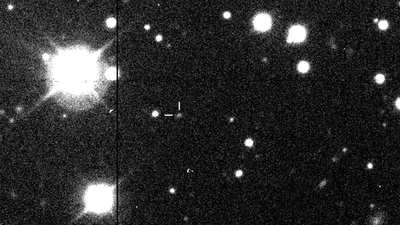
Sheppard now has two new moons to add to his already ridiculously long list of discoveries, as the International Astronomical Union's (IAU's) Minor Planet Center confirmed two new objects around Jupiter; S/2017 J 11, and S/2017 J 10.
As you may infer from the names, the moons were first observed in 2017, but follow-up observations were required to confirm that they were really there, as well as that they are in orbit around Jupiter.
Not a huge amount is known about them, but we do know that they are both small moons on a retrograde orbit around the planet, meaning that they are moving around Jupiter in the opposite direction to Jupiter's rotation, which is not unusual for Jupiter's smaller, outer moons.
S/2017 J 11 takes around 701 days (1.92 Earth years) to orbit around Jupiter, with an average orbit distance of around 0.1520226 astronomical units (AU), with one AU being the distance between the Earth and the Sun. That is an average distance of 22,742,257 kilometers (14,131,383 miles) in more familiar units. S/2017 J 10's orbit is a little closer, at an average distance of 0.1438750 AU (21,523,393 kilometers, or 13,374,016 miles), and completes an ellipse around the planet every 646 days (1.77 Earth years).
These two new moons join Jupiter's 95 others, bringing the grand total of Jupiter's moons officially recognized by the IAU to 97. Until, of course, one Scott Sheppard finds some more.