Space and Physics
 PUBLISHED


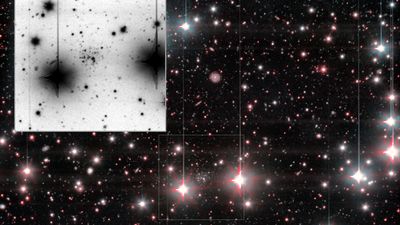


Astronomers report the discovery of a brand-new ultra-faint dwarf galaxy around Andromeda, the closest large galaxy to our own. This object, known as Andromeda XXXVI, or simply And XXXVI, is fascinating. It is old, small, and right at the edge of what we would categorize as a galaxy.
Dwarf galaxies are satellites of major galaxies, orbiting around the big dog of their galactic neighborhood. They aren’t the only collections of stars that orbit galaxies. Globular clusters are densely packed spherical groups of stars that orbit galaxies too, sometimes with 1000s of stars across a handful of light-years.
With just 40 stars, And XXXVI might seem to be a better candidate for this latter group. The luminosity of the object and its size (about 200 light years across), however, match the general population of Andromeda dwarf galaxies. Still, it is extremely faint, and many mysteries remain, such as its precise distance, age, and chemical makeup, a parameter known as metallicity.
Let’s say that we never discover any more satellites after Andromeda XXXVI – this would raise important questions regarding the accuracy of state-of-the-art cosmological simulations of galaxy formation, and even our understanding of the nature of dark matter.
Joanna Sakowska
“We would need the precision of space telescopes (such as the Hubble Space Telescope) to resolve And XXXVI further and better constrain its distance, age, and metallicity. What is clear, however, is that And XXXVI is one of the faintest satellites of Andromeda found to date,” lead author Joanna Sakowska at the Astrophysical Institute of Andalusia in Spain told IFLScience.
Crucial to the discovery – which has yet to be peer reviewed – was amateur astrophotographer Giuseppe Donatiello, who looked through the many images from the Pan-Andromeda Archaeological Survey (PAndAS) to identify what the team calls “promising, semi-resolved blobs.” He found two, and the team used the OSIRIS+ instrument on the Gran Telescopio Canarias to follow up on the object. Observations and some modeling provided the data needed to claim a discovery.
“And XXXVI points towards the possibility of an extremely faint population of satellites, waiting to be discovered. So far, we know of about 40 dwarf galaxy satellites, of which about 15 are classed as ‘ultra-faint’,” Sakowska told IFLScience.
It is actually expected that there are even more of these extremely faint galaxies orbiting Andromeda. Finding them is a challenge, but getting accurate measurements has important implications, not just for our understanding of galaxies, but for our understanding of the universe as a whole: the standard model of cosmology.
“The expected number of dwarf galaxy satellites is not quite certain, as the prediction changes depending on which cosmological model of galaxy formation is adopted. However, following the popular lambda cold dark matter model [i.e. the standard model], some estimates suggest Andromeda should have around 90 satellites,” Sakowska explained.
“Let’s say that we never discover any more satellites after Andromeda XXXVI – this would raise important questions regarding the accuracy of state-of-the-art cosmological simulations of galaxy formation, and even our understanding of the nature of dark matter.”
Sakowska and her team praise the collaboration between citizen scientist Donatiello and astronomers as a key reason for this discovery.
“These kinds of wonderful discoveries are made possible by astronomy enthusiasts collaborating with professional scientists. And XXXVI would have remained undetected otherwise. There is still much to be learnt about And XXXVI, and we hope it will be investigated further with space telescopes and future instruments,” Sakowska stressed.
The paper is submitted to Astronomy & Astrophysics and available on the arXiv.