Space and Physics
 PUBLISHED



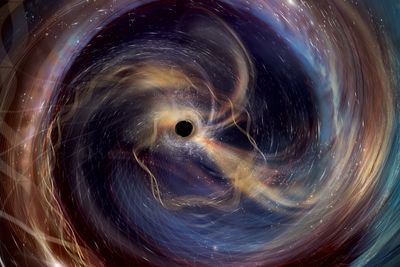


On January 14, 2025, the Laser Interferometer Gravitational-Wave Observatory (LIGO) detected GW250114. This was a collision between two black holes of 30 to 40 solar masses, and it happened around 1.3 billion light-years from Earth. It was the loudest gravitational collision on record.
This loudness, the clarity of the signal, allowed researchers to see something very exciting: a feature consistent with signals from near the event horizon. This is the surface of no return, the threshold separating the inside of a black hole from the rest of the universe. Once you cross the event horizon, you can't escape the black hole.
“GW250114 is an unusually loud and clean black-hole merger, which makes it a rare opportunity to look for subtle features in the gravitational-wave signal,” Sizheng Ma at the Perimeter Institute in Canada told IFLScience.
“When we analyzed this event, we found evidence for a component consistent with a direct wave — a signal that carries the imprint of the region very close to the newly formed black hole’s horizon. In simple terms, it looks like we may be hearing the final, rapidly fading motion of spacetime near the edge of the black hole.”
The researchers see this as a first step into studying a complex and fascinating feature of black holes. Event horizons can be described mathematically, but to actually observe effects that probe their properties would be a revolution.
“That is exciting because the event horizon is usually thought of as something almost impossible to probe observationally. GW250114 may be giving us one of the clearest hints so far that gravitational waves can carry information from right next to that boundary,” said Ma.
Gravitational wave detections are reliant on incredible observatories – which record the highest precision measurements ever made by humanity – and also very strong theory. The latter allows extracting a lot more information from the signal. For example, researchers recently reported a black hole collision in which one of the colliding partners was itself the product of another collision.
In the case of GW250114, the team was able to extract this direct wave, and there they found evidence of something called frame dragging. When a massive object spins on its axis, it carries spacetime around with it, a bit like a whirlpool. This has been measured around planets and even supermassive black holes. In a gravitational wave signal, though, it could become a window onto the event horizon itself.
“Near the horizon of a rotating black hole, the frame-dragging effect becomes extremely strong,” Ma told IFLScience. “During a merger, the spacetime close to the newly formed black hole is not just vibrating, it is also being swept around by the black hole’s rotation. That motion leaves an imprint on the gravitational waves that travel outward to our detectors. Specifically, the gravitational waves oscillate at or close to the characteristic frequency set by this dragging motion.”
In the decade since the first detection of gravitational waves, there have been improvements in the detectors and the theory. The events we detect are now clearer and a lot more numerous. This will allow population-wide studies on this frame-dragging effect, and it might provide new understanding of what actually goes on just at the edge of a black hole.
“In the future, we want to improve the theory, test the method on more events, and see whether this near-horizon signature appears consistently across black-hole mergers. If it does, it could become a new way to study the edge of black holes and test Einstein’s theory in one of the most extreme environments in the universe,” said Ma.
This study has been published in the journal Nature.