Space and Physics
 PUBLISHED


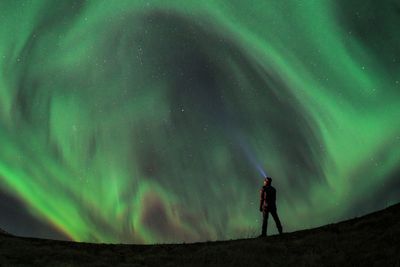


The gnarly solar weather that brought spectacular aurorae to the US and Canada earlier this week looks set to continue, with a coronal mass ejection (CME) expected to hit Earth at some point today (August 3rd). In anticipation of the event, the National Oceanic and Atmospheric (NOAA) has issued a moderate geomagnetic storm warning, stating that the Northern Lights could become visible as far south as New York.
A CME is a large wave of plasma and magnetic fields thrown out by the sun. When these electrically charged particles collide with the Earth’s magnetosphere, they have the potential to trigger geomagnetic storms, sometimes producing aurorae.
The CME currently hurtling towards us was associated with a potent M8-class solar flare that erupted from the sun on August 1st. According to the NOAA, the plasma wave is expected to arrive “between midday to late” (UTC) today, which means the night skies could dance with color as the geomagnetic storm rages through to the early morning.
“The aurora may become visible over some northern and upper Midwest states from New York to Idaho,” says the NOAA.
Earlier this week, a minor G1 geomagnetic storm associated with a pair of CMEs produced bright aurorae over large areas of the northern hemisphere. With the upcoming storm predicted to reach G2, then, tonight’s spectacle could be even more jaw-dropping.
Back in May, stargazers were treated to some of the brightest and most widespread aurorae for several years as a G5 geomagnetic storm - the highest possible rating - slammed into Earth. It’s unlikely that the current CME will trigger such a dramatic event, although with the solar maximum approaching, the storms and flares are expected to continue.
Denoting the peak of the sun’s 11-year activity cycle, the solar maximum is associated with an increase in sunspots. These are areas on the surface of the sun where the magnetic field is particularly strong, and from which flares and CMEs tend to arise.