Humans
 PUBLISHED



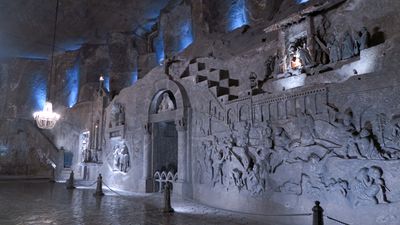


A hidden empire of salt lies beneath southern Poland, not far from Kraków. Salt has been harvested here for thousands of years, but when mining ceased in the 1990s, the site evolved from a medieval industrial hub into a subterranean masterpiece dedicated to all things sodium chloride, featuring a sprawling complex of chapels, museums, and sculptures, all carved from "the white stuff".
Salt is deeply encrusted onto the history of Wieliczka. Around 13.5 million years ago, seawater flooded this basin at the feet of the Carpathian Mountains in Central Europe. Then, slowly but surely, tectonic plates shifted and the water was drained, leaving behind tonnes and tonnes of salt in the local geology.
Archaeologists discovered the oldest saltworking tools in Central Europe at a plot very near the town, dating back to the Neolithic Age. Brine would be obtained from natural springs, then boiled in a pot until the water evaporated, leaving a salty residue that could be used for food seasoning or, more likely, preservation.
This practice continued until the 11th and 12th centuries CE when the salt springs began to vanish. This led to the construction of saline wells and eventually mines in Wieliczka. The site was actively mined here from the 13th century, making it one of the oldest known salt mines in the world.
Mining continued until 1996, by which time it was already a UNESCO World Heritage Site and an official Polish Historic Monument. Today, the Wieliczka Salt Mine is a sightseeing attraction, but it’s much more than just a tourist trap with a gift shop.
The mine features over 245 kilometers (152 miles) of tunnels that burrow down nine levels, reaching 327 meters (1,072 feet) at the deepest point.
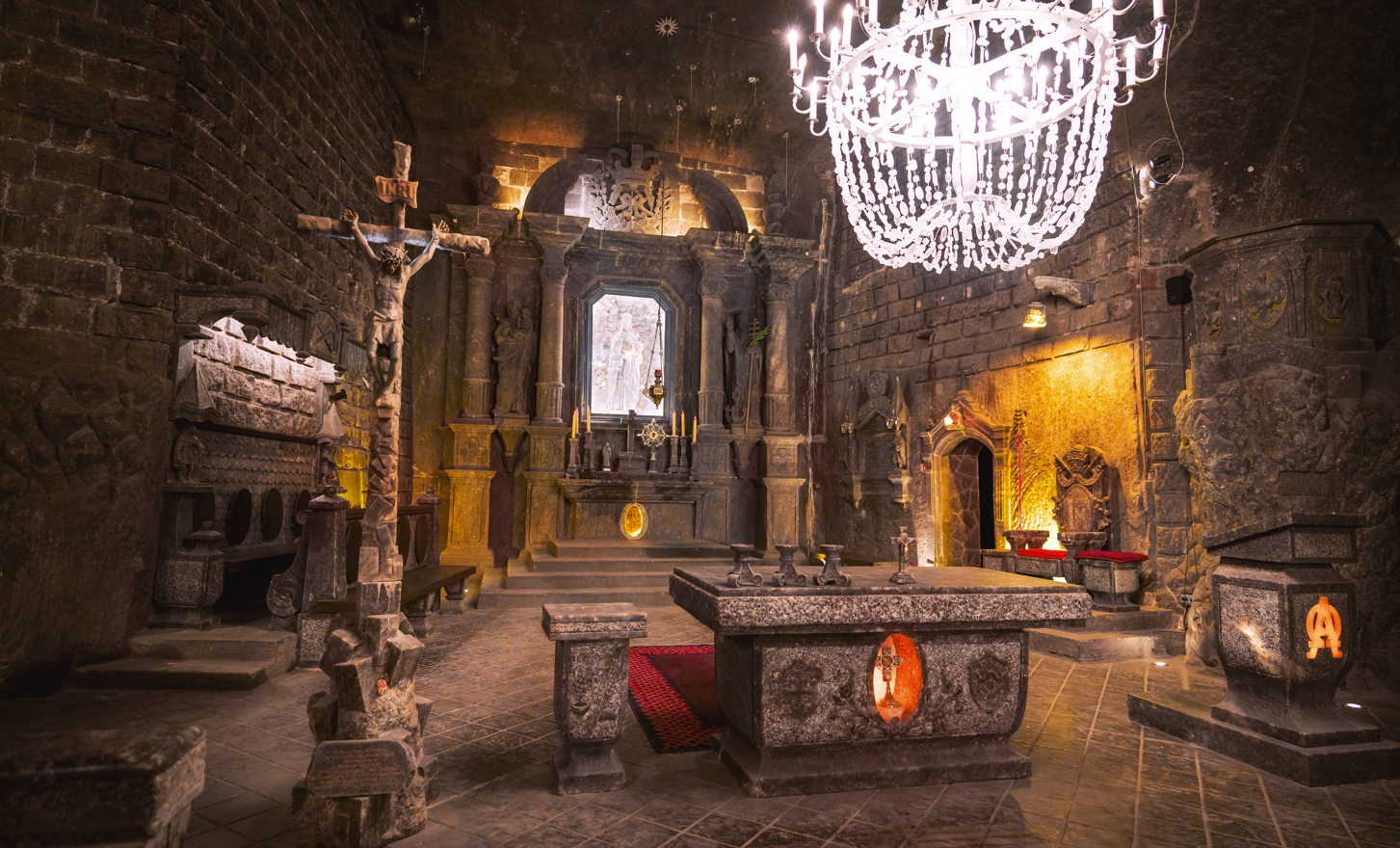
One of the most impressive features is St. Kinga’s Chapel, created by miners working in the dingy depths (who no doubt had a very good reason to pray). Located on the second level, around 101 meters (332 feet) underground, it features a beautifully eerie hall adorned with a giant chandelier and crosses, as well as a salt-carved statue of John Paul II, the relatively recent Polish pope, and a replica of Leonardo da Vinci’s The Last Supper.
Many great minds of European history have walked these corridors, including Johann Wolfgang von Goethe, the writer behind the deal-with-the-devil drama Faust, and Alexander von Humboldt, the pioneering naturalist who inspired the name of the Humboldt penguin and Humboldt squid. It was even visited by Nicolaus Copernicus, the Polish polymath who proposed a heliocentric system that stated the planets orbit around the Sun, not Earth.
And now, for around 143 Polish Zloty (~$40) you can visit too!