


 Space and Physics
 PUBLISHED


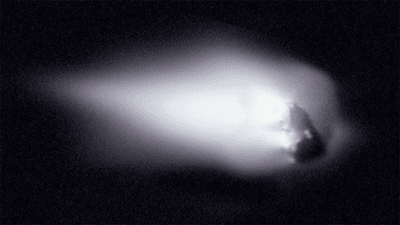


A new preprint paper has outlined how humanity could catch up with Halley's comet on its next close approach to the Sun. It's a surprisingly difficult task, but would be totally worth it.
Halley's comet is actually a pretty difficult object to study up close, and humanity knows this because we have tried, with limited success. The comet is on a retrograde orbit, traveling backwards relative to the Solar System's planets, making it exceptionally energy-expensive to visit, especially if you want to make any significant observations of the comet and its nucleus.
In 1986, we tried anyway, sending several missions to visit it as it approached the Sun. Whilst we did get a glimpse of the comet, we had to do so whilst hurtling towards and then past it at relative velocities of 70-80 kilometers (43-50 miles) per second.
"Only one hemisphere of the nucleus could be imaged, and the rotational state could not be accurately measured," the team explains in their paper.
"Scientists are tempted to explain the nucleus of Halley as a contact binary, but only an extended collection of high-resolution images covering the entire body can confirm this hypothesis."
If we want to resolve this and other questions, such as mass loss of the object as it approaches the Sun, or questions about its surface composition, the team suggests we need to catch up with Halley's comet again at much lower relative speeds, and beyond the orbit of Mars.
Why Halley's comet at all? It sounds pretty difficult to reach?
There are plenty of comets to choose from, so why Halley's Comet? According to the paper, one appeal of visiting the comet (with the main appeal being its scientific value) is its cultural significance, and on these grounds it is difficult to argue.
The history of Halley's comet from humanity's perspective goes back at least 2,200 years, and likely far longer given how bright it is in the night sky as it approaches the inner Solar System.
The first appearance of the comet in historical records is from Chinese astronomers way back in 239 BCE, whilst a 2010 paper argues that the comet was documented before this by Ancient Greeks in 466 BCE.
The comet has been significant throughout history, making a surprise guest appearance in the Bayeux Tapestry, everyone's favorite not-technically-a-tapestry chronicling the Battle of Hastings in 1066. Back then, it was seen as a sign from the heavens, rather than a big (but glorious) chunk of space rock.
"As it first appeared in April of that year, observers in England saw it as a bad omen, portending great change for the Anglo-Saxon kingdom ruled by King Harold, while Duke William of Normandy believed it was a positive sign from heaven," NASA's John Uri explains.
"The 11th century 230-foot long Bayeux Tapestry, more accurately an embroidery and most likely made in England, depicts scenes leading up to the Norman invasion of England and William’s ascendancy to the English throne. One of the scenes depicts a comet that has been identified as the first illustration of Halley’s Comet."
By now you may have noticed that this comet was seen by an awful lot of people who weren't named "Halley".
It came to be named after British astronomer Edmond Halley. In 1705, Halley used Newton's recent theory of gravity to show that the objects seen in the night skies of 1531, 1607, and 1682 were in fact the same comet on an orbit of around 76 years, and correctly predicting its next appearance in our skies.
So how do we catch this retrograde miscreant?
There have been many other proposals for missions to visit Halley's Comet, but these have largely relied on speculative technologies delivering the thrust needed to catch up to it.
In the new paper, the team attempted to look at missions that could reach the comet using technology that actually exists, which is always a nice bonus. It is not the first paper to do so, but it does present us with some nice options for an exciting, if slow, mission to the comet in several decades' time.
As you are probably expecting, the mission involves our old friend the gravity assist (GA). In fact, it involves two of them, taking a spacecraft around both of our Solar System's gas giants.
"The GA with Jupiter inserts the spacecraft into a high-energy hyperbolic trajectory to Saturn," the team explains in their paper.
"A Saturn GA changes the inclination to reach the orbital plane of Halley. Finally, the propulsion system adjusts the trajectory to complete the rendezvous with the comet," they added.
The mission requires Jupiter and Saturn to line up nicely. While the team identified many opportunities for gravity assists with Jupiter, they needed to be at the right time and place in order to send the spacecraft to Saturn with as little fuel use as possible.
That ruled out a lot of options, but the team was able to identify a number of options with departure dates in the 2030s in order to make it to Halley's Comet.
"The best solution with a 2036 departure, assuming a wet mass of 2,000 kg [4,400 pounds], launches on August with C3 = 103 km2s−2. It reaches Halley on September 2060, 4.57 au [astronomical units] from the Sun, with a dry mass of 1,027 kg [2,264 pounds]," the team explains.
"An alternative trajectory, with departure on September 2037 and C3 = 109 km2s−2, also reaches the comet on September 2060. The rendezvous occurs 4.63 au from the Sun, with a final mass of 916 kg [2,019 pounds]."
That final mass at the end there is important, representing fuel for running the spacecraft as it approaches the comet.
The team notes that the launch energies required for the mission were high, though not extraordinary. Additionally, the team says that designing a spacecraft with the mass requirements of the 2037 mission in mind means that the 2037 trajectory would be possible, were the earlier and preferred 2036 launch be missed.
The paper, yet to undergo peer review, is posted to preprint server arXiv.



 2
2