Humans
 PUBLISHED



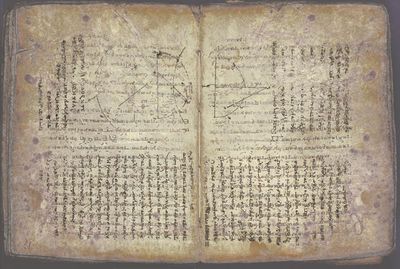


Report long enough on palaeological and archaeological breakthroughs, and you start to notice some trends. Like: it’s amazing how many times priceless relics are found collecting dust in a drawer somewhere.
This week, it’s the turn of a lost page from an ancient Greek manuscript written by one of the most famous scientists in history, which researchers at France’s CNRS say is “one of the most important surviving manuscripts of antiquity”.
A total surprise
It started off as a joke. “Hey, let's see if there's a palimpsest in Blois,” Victor Gysembergh, the researcher at CNRS who – spoiler alert – found the artifact, told his office colleagues.
It was said in jest, but it wasn’t totally far-fetched: the city of Blois had been favored by the nobles and royals of the ancien regime, France's political system from before the revolution, with the kings keeping part of their library there. It was, in other words, exactly the kind of place an ancient manuscript page might be lingering.
Nevertheless, it was a surprise when, deep in the archives of the city’s museum of fine art, they found precisely that. “It was very unexpected to stumble upon a Greek manuscript,” Gysembergh told France 24 last week. “And even more so to find a 10th-century scientific treatise!”
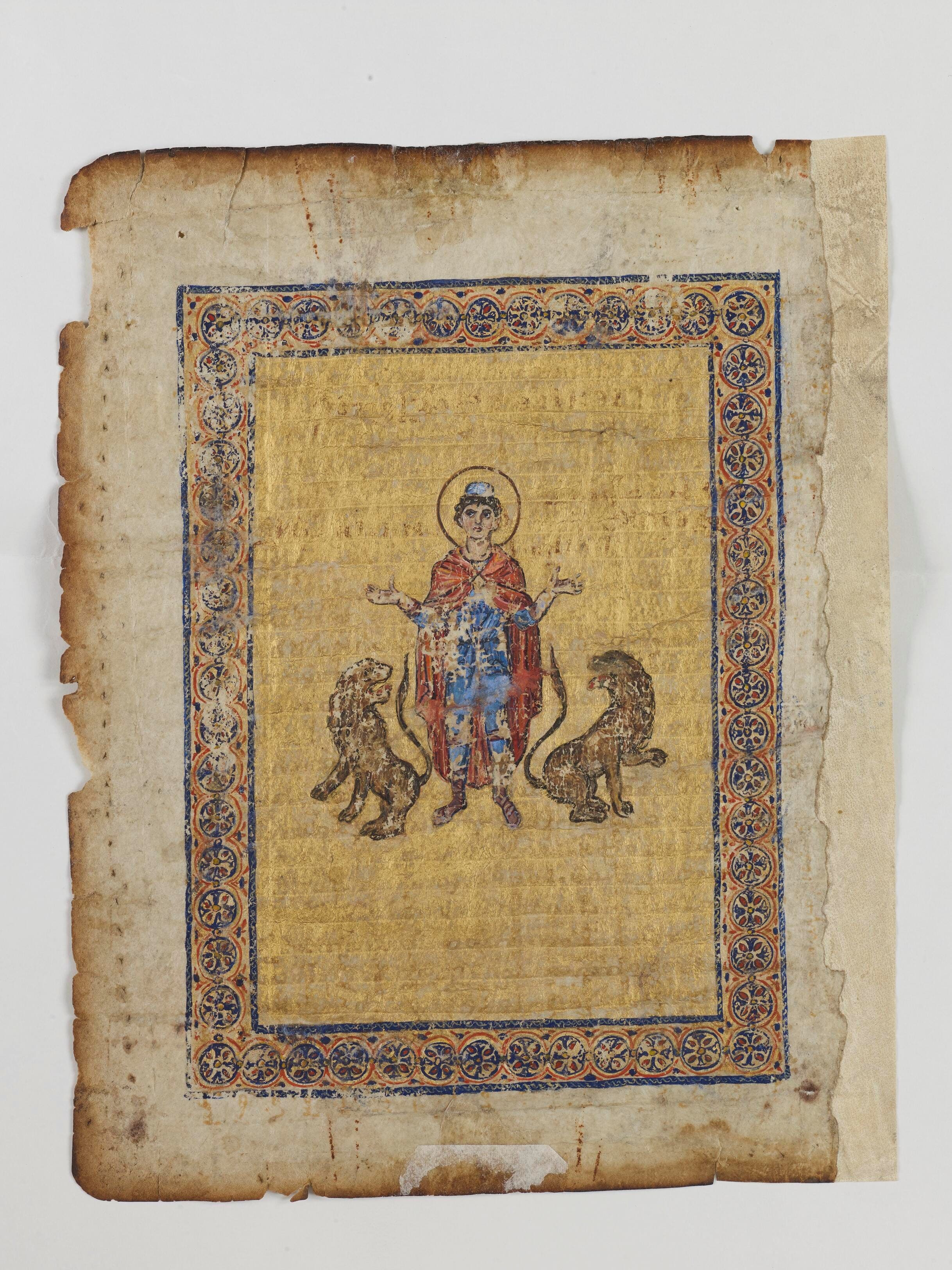
His search of the museum’s online catalogue had turned up a single page: illuminated on one side was the Tanakh prophet Daniel and two lions; on the other were crisscrossing lines of painstakingly copied Greek lettering. The illustration, despite appearances, turned out to be less than a century old – added in the 1940s in a confused attempt to increase the manuscript’s market value. The other side, however, was something special.
What Gysembergh found seemed oddly familiar. Behind the Byzantine Christian prayers, transcribed in 1229 by a resourceful monk with a dearth of fresh parchment, there were geometric diagrams and mathematical propositions. They described a series of middle steps in the process of finding the area of a sphere, something done for the first time by Archimedes in his 225 BCE treatise On the Sphere and Cylinder – but surely, it would be too much to hope that this could actually be a missing page from Archimedes Palimpsest?
A checkered history
The Archimedes Palimpsest is one of just three scraps of evidence that Archimedes – yes that Archimedes: the ancient Greek mathematician, physicist, engineer, astronomer, inventor, and notorious yelling nudist – was more than just a legend.
It’s something of an omnibus work: the full document contains not just On the Sphere and Cylinder, but six other mathematical and physical treatises, a selection of political speeches from Hypereides, and a commentary on a work of Aristotle. But as important as such a text might sound to us today, it wasn’t always so revered.
“Archimedes wrote his treatises on papyrus rolls, the originals of which have been lost,” explained Mary Miller, then a producer for San Francisco’s Exploratorium science museum and part of the team documenting an investigation of the Palimpsest back in 2007. “But his works were faithfully copied by generations of scribes and made the leap onto bound goatskin parchment by sometime late in the fifth century, probably in Constantinople [modern-day Istanbul].”
These would have been kept safe in the city’s great libraries – right up until the crusades, when invading Western armies looted, pillaged, vandalized, and destroyed just about everything and everyone they found. By some fluke, one parchment, already 300 years old, made it out, finding safety within the walls of St Sabbas’s monastery in Palestine.
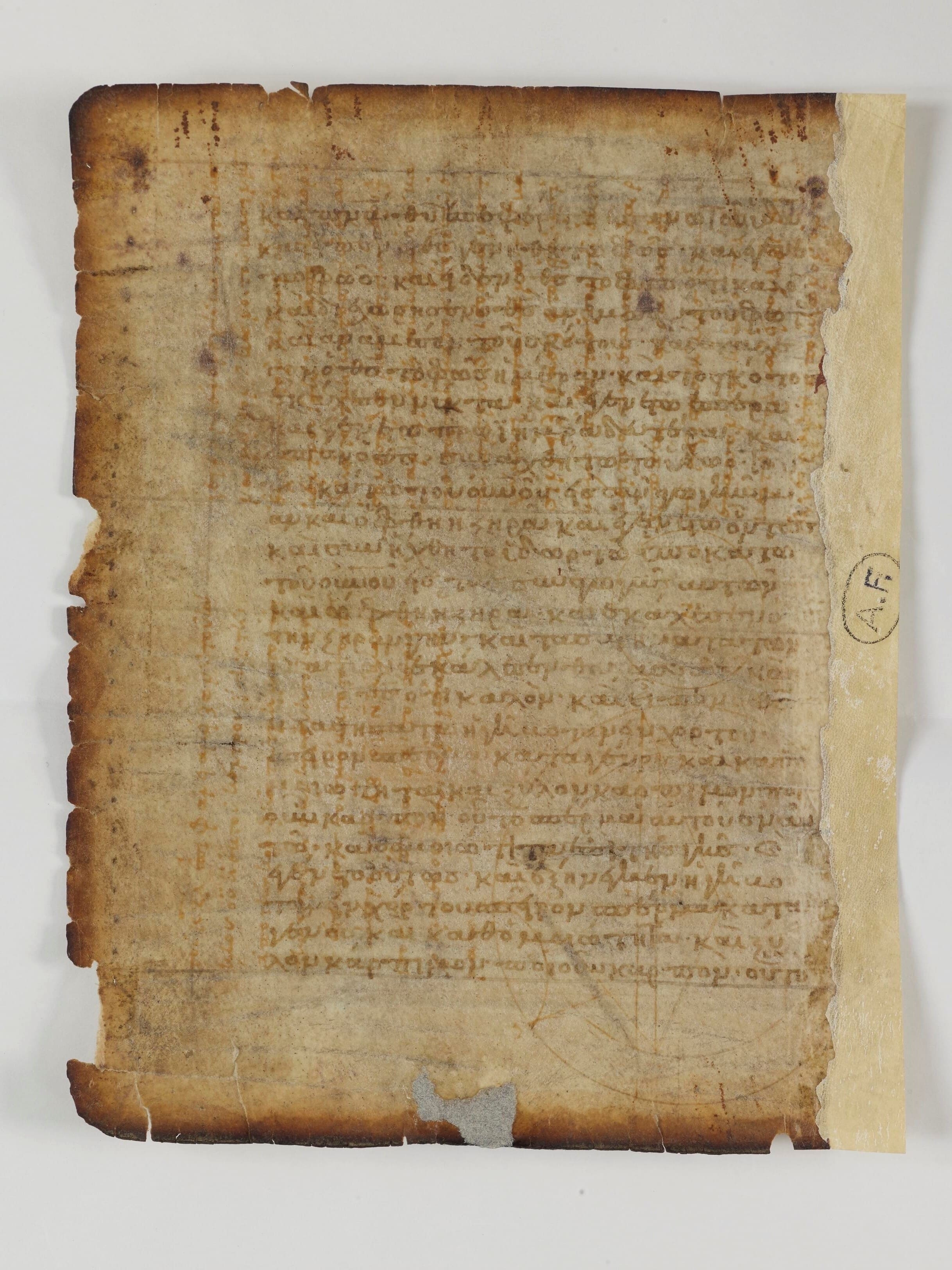
Just 25 years later, however, one man did what the Fourth Crusade could not. “In 1229, a Greek priest who needed parchment for a prayer book took apart the Archimedes manuscript,” Miller wrote. “[He] scraped and washed off the pages and copied liturgical text on top of Archimedes' writings in a process known as palimpsesting.”
“Horrifying as that seems now, the original text probably would not have survived had the scribe not recycled it and subsequent monks not preserved the prayer book,” she added.
And there the story would have ended – the palimpsest secreted away in an isolated monastery; Archimedes’s work hidden behind a selection of medieval prayers – if not for one Johan Heiberg. It was he who, in 1906, visited the palimpsest and took detailed photographs of every page, committing to the world’s memory the entirety of the manuscript.
It was a new era of fame for Archimedes. Heiberg, a professor of philology at the University of Copenhagen, knew what he was looking at under those prayers, and he tried his best to decode what he could. He published scholarly articles on the parts he could decipher, and published his photographs as part of a new complete works of Archimedes in the 1910s.
Then, everything went sideways.
Tragically lost
The Archimedes Palimpsest survived the Crusades. It survived empires rising and falling; being moved, scraped, cut in half and overwritten. But in the years around 1920, something happened that it couldn’t overcome.
As a bloodthirsty ethnic nationalist war raged between Greece and Turkey, the palimpsest went missing. “Removed from the library under mysterious circumstances – possibly stolen from the monastery – [it] is believed to have been in the hands of a French family for much of the 20th century,” Miller wrote. “It resurfaced again in 1998, when an anonymous private collector in the United States bought the document at auction for $2 million.”
The sale wasn’t without controversy. Both the Greek Patriarch – kind of the Eastern Orthodox equivalent of the Pope – and the Greek government tried to intervene, issuing an injunction against Christie’s, the auction house making the sale. The palimpsest was stolen goods, they argued, and any sale would be illegal.
Rumours abounded over who that purchaser might be, with one popular choice being exactly the billionaire "Mr B" you're thinking of right now - but according to insiders, that's not the case. "Though I can't tell you who the owner is, I can say that whom is [sic] is not," one expert who worked on the Palimpsest between 2000 and 2011 told IFLScience. "It isn't Jeff Bezos".
But as much money as the new owner may have spent, he had nevertheless been shortchanged. “The book [had] suffered greatly since the time when Heiberg saw it,” explains the Archimedes Palimpsest Project. “Firstly, some pages are missing. The most important are three missing pages that once contained Archimedes text.”
“We know that they were there in 1908 as Heiberg transcribed them, and even took a photograph of one of them,” the Project says. “They are simply not there now.”
Illuminated at last
When Heiberg took those photos more than 100 years ago, he might not have known how important they would end up being to the palimpsest itself. But it was thanks to his images that Gysembergh was able to confirm what he had found: page 123 of the Archimedes Palimpsest.
Everything matched up: the handwriting was the same; the figures; even the mistakes were the same, Gysemberg told France 24. And that’s just what he could see with the naked eye! Subject to getting permission from the page’s custodians, he hopes to use multi-spectral imaging and analysis to further illuminate – no pun intended – the secrets under the prayers.
It would be the kind of understanding of Archimedes’s work that Heiberg could have only dreamed of. And yet, until two more pages are found, he still had a more complete picture of the palimpsest than we do today.
With his surprise find, however, Gysembergh hopes that may soon change. “Until this discovery, we had no reason to hope we would ever find [the pages]," he said.
But now, “if institutions or private collectors have this kind of manuscript, they should think about whether it could be one of the other lost pages.”
This article was amended to include a comment about the nature of the current owner of the Archimedes Palimpsest.