Health and Medicine
 PUBLISHED



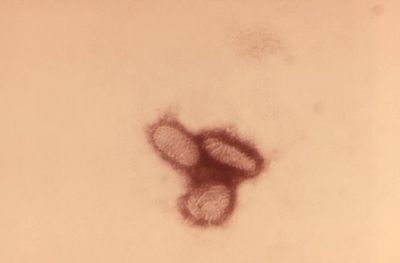


A human gene found in a poxvirus is displaying a behavior geneticists have never seen before.
Not only is it the first time that a segment of DNA known as a “jumping gene” is both active and movable, it is also the first reported instance of a one of these genes hopping from the human genome into that of a human virus.
Movable DNA
We might like to think of DNA as being stable and incorruptible, but that is far from the case. Out DNA is frequently altered through processes such as mutations, but also something called Transposable Elements (TEs).
Known as “jumping genes”, these sections of DNA can find themselves cut out of the genome and then placed in new regions, meaning that they appear multiple times as repeats.
Almost half your DNA is made up of TEs, demonstrating their extraordinary success while only occasionally providing anything of value. However, if genes could multiply indefinitely then genomes would become large and unwieldy, so the capacity to jump is rare.
So sometimes TEs put their free-roaming days behind them and become productive members of an organism’s genome and help it to survive, in a process known exaptation.
The BC200 human gene is a well-known example of this. The BC200 gene has been in the primate family tree for around 40 million years and has is widely replicated in most primate genomes and primarily expressed in our braincells.
The gene has gone from being a genetic free-rider to being transcribed into noncoding RNA that is abundant in primate dendrites, the long extensions of neurons.
Exactly what role the BC200 RNA provides in primate neurons is still something of a mystery, but it’s almost certainly important. It has also been found that the brains of people with Alzheimer’s have an excess of this RNA suggesting its presence is a two-edged sword.
What is extraordinary here, however, is that researchers found not one, but two independent copies of the BC200 gene in a human poxvirus.
Jumping genes
The presence of the BC200 human gene in the poxvirus “blurs the line between gene and transposon”, writes the authors of this latest study. That's because up until now it no one had ever found a gene that is both a mobile TE and required for bodily functions.
Fortunately, the poxvirus involved is the molluscum contagiosum virus (MCV), which creates unsightly bumps but is rarely dangerous. This means we can focus on what this discovery teaches us about this gene, without feeling doubly aggrieved that our own DNA is being used to harm us.
Pox viruses are known to sometimes copy genes from the species they infect. Dr Cedric Feschotte of Cornell and co-authors compared the MCV virus, which only infects humans, with known human genome sequences, and found two examples that appear to be based on the BC200 gene.
Further investigation by the researchers supported their suspicion that a BC200 gene from a human infected with MCV had inserted itself into the virus.
Incredibly, however, the two sperate sequences of the BC200 gene the team found in the virus appear to the products of independent transfers, most likely having occurred thousands of years apart.
“Poxvirus genomes exhibit a high deletion rate that should quickly purge all nonessential sequences and that results in frequent gene loss,” write the authors.
The fact that one of the BC200 insertions was at least 25,000 years ago, and the other a minimum of 31,000 years ago, suggests the virus is also finding these genes useful.
Since MCV is low on the list of viruses we need to destroy, the authors are less interested in how to use the BC200 gene against MCV and more focused on what the discovery says about genetic flexibility.
Genes hopping between species?
There have been a couple of other cases in which genes have been seen to jump from host into virus. The first of these was in a moth, but another came in the form of a rodent.
In this case, it was the first time that a vertebrate gene had been found to do this, but more astonishingly still, the gene in the virus infecting the rodent originally came from.... a snake.
"I think at the time it was the first and only case of a clearly vertebrate transposable element escaping into a virus in the wild," Feschotte said in a statement.
Having discovered BC200 in the MCV, the authors then looked into whether it has recently found itself new homes within our own genome. And they concluded that it has.
“All primate species examined that contain the BC200 gene have accumulated dozens to hundreds of lineage-specific BC200 insertions,” they report. This includes recently among humans.
Geneticists had previously considered functional genes that perform some useful role and active TEs as distinct. That is, genes could be footloose and fancy free, but once they have settled down and started contributing to the organisms' DNA, they put these ways aside.
This has never been seen before in humans, with the rodent gene BC1 being the “closest parallel” they are aware of.
The study is published in Science



 2
2