Space and Physics




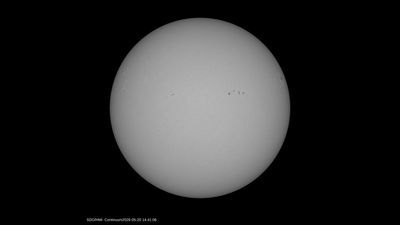


The Sun’s activity ebbs and flows in 11-year-long cycles, and it has just passed its peak. The minimum is still several years away, however, so it isn’t unusual to see a group of sunspots from which a powerful solar event might be generated. What’s exciting this week is that we know a large group is coming, but we wouldn’t have known simply by looking at the Sun from Earth.
If you look at the Sun today – with a solar telescope or binoculars, never with the naked eye – you will see a handful of sunspots. All small, a few far apart, and a little group that is now moving towards the eastern side. The view from our planet obviously misses what’s happening on the other side of the Sun, though, and it appears there’s trouble brewing there.
A large sunspot group was seen forming on the Sun’s far side by Solar Orbiter, a mission from ESA, the European Space Agency, with the support of NASA. The spacecraft is studying the Sun like never before, even revealing the first images of the Sun’s poles, and since it goes around the Sun faster than Earth, it sometimes catches a completely different view of our star than we get on the ground.
According to the Space Weather Prediction Center of the National Oceanic and Atmospheric Administration (NOAA), the presence of this group of sunspots might lead to a review of their space weather forecast from today and beyond. The Solar Orbiter measurements also show that the magnetic map of the region is a bit of a mess.
Sunspots are regions of the surface of the Sun that are cooler due to intense magnetic fields. The sunspot becomes the anchor of large magnetic streams extending above the surface. Those magnetic fields can accumulate a lot of energy, becoming tangled. They can snap and realign, releasing the energy as solar flares, which can be responsible for geomagnetic events on Earth, from telecommunication blackouts to spectacular aurorae at lower latitudes.
Based on the Solar Orbiter data alone, it is possible the region is already decaying, and once it comes into view of Earth, it will end with a whimper and not a bang. Still, it might turn out that the region still has some surprises for us, so it is very important to keep an eye on it.
Whether this group has an explosive future ahead of it or not, it is incredibly cool that we can now, on occasion, keep a 360-degree look on the whole of the Sun.