Nature
 PUBLISHED


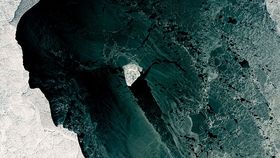


One of NASA’s eyes in the skies, the Landsat 8 satellite, has spotted a very large jewel of ice glistening in the Caspian Sea.
The image was acquired on February 4 as the satellite orbited far above where the sea meets western Kazakhstan. The natural-color images beautifully show off all the different ice types that can form in the area. The brown ice shows the Volga Delta, where the Volga River – Europe's largest river system – drains into the Caspian Sea. The white areas denote the thinnest part of the ice, a 1-meter (3.3-foot) thick expanse of consolidated ice.
“This ‘island’ of white ice is most probably a piece that detached from the ice field,” Alexei Kouraev, a scientist at the Laboratory of Geophysical and Oceanographic Studies in France, told NASA Earth Observatory.

NASA
While you might be mistaken for thinking this diamond is floating around like an iceberg, it's more likely this chunk of ice was chipped off from the larger sea ice and then became grounded to the seabed. As the image shows, there's a "shadow" around the ice diamond, displaying where water currents have moved around it.
They also released an image of the area with thermal data (below). As spring slowly but surely arrives, this ice will soon disappear, so you can expect this image to become more and more orange over the coming weeks and months. At this stage of the season, the thermal imaging also gives a good indication of the ice thickness.
It just so happens to look rather pretty too.

NASA
[H/T: NASA Earth Observatory]